BSNL SET Telecom Notes
Free chapter for students preparing for BSNL SET.
Spectrum management is the organised regulation of radio frequencies to ensure different wireless services — mobile, satellite, Wi-Fi, defence, aviation, broadcasting — can all operate simultaneously without interfering with each other.
Radio spectrum is a finite natural resource. Unlike optical fiber (which can be expanded by laying more cables), the usable radio spectrum has fixed physical limits. Every country and every mobile operator must work within an allocated slice of it.
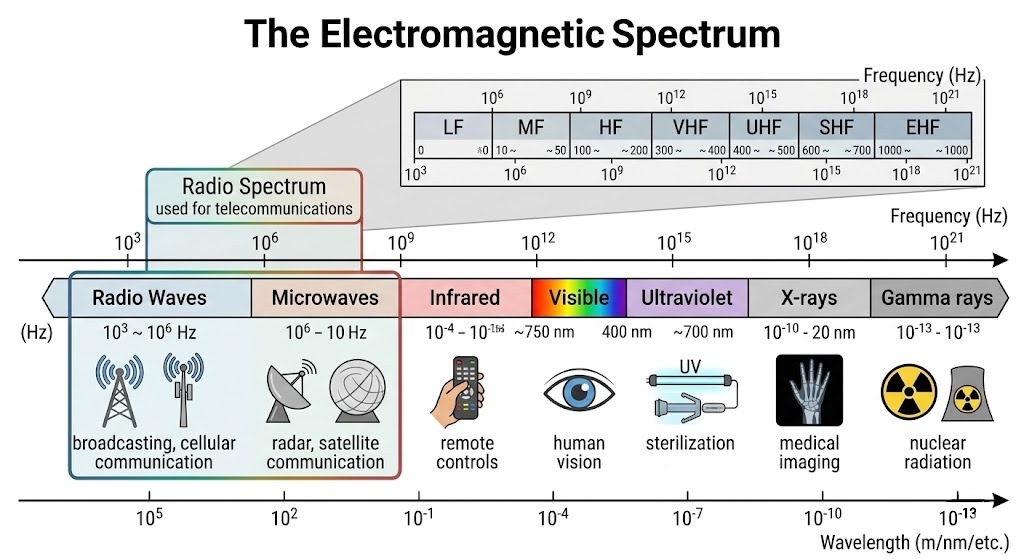 The electromagnetic spectrum from ELF radio waves through microwave and beyond. Telecommunications primarily uses the Radio Frequency (RF) and Microwave portions.
All electromagnetic waves travel at the speed of light. What differs between them is their frequency (and corresponding wavelength). Radio and microwave frequencies are the ones used in telecommunications.
| Band | Full name | Frequency range | Typical telecom use |
|---|---|---|---|
| ELF/VLF | Extremely/Very Low Frequency | 3 Hz – 30 kHz | Submarine communication |
| LF/MF | Low/Medium Frequency | 30 kHz – 3 MHz | AM radio, maritime, navigation |
| HF | High Frequency (shortwave) | 3 MHz – 30 MHz | Long-distance radio, SSB voice |
| VHF | Very High Frequency | 30 MHz – 300 MHz | FM radio, VHF TV, air traffic control |
| UHF | Ultra High Frequency | 300 MHz – 3 GHz | Mobile (GSM/3G/4G), Wi-Fi, DTH |
| SHF | Super High Frequency (microwave) | 3 GHz – 30 GHz | Microwave backhaul, satellite, 5G mmWave |
| EHF | Extremely High Frequency (mm-wave) | 30 GHz – 300 GHz | 5G mmWave, satellite broadband |
Exam point: The UHF band (300 MHz – 3 GHz) is where most mobile communication happens — GSM (900/1800 MHz), 3G (2100 MHz), 4G (700/800/1800/2100/2300/2500 MHz), and Wi-Fi (2.4 GHz/5 GHz).
Wavelength and frequency are inversely related: where = speed of light (3 × 10⁸ m/s), = frequency in Hz.
Exam point: Spectrum is treated as a national resource. In India it is managed by the government and distributed through policy and auctions.
Spectrum regulation flows from international treaties down to individual operator licences.
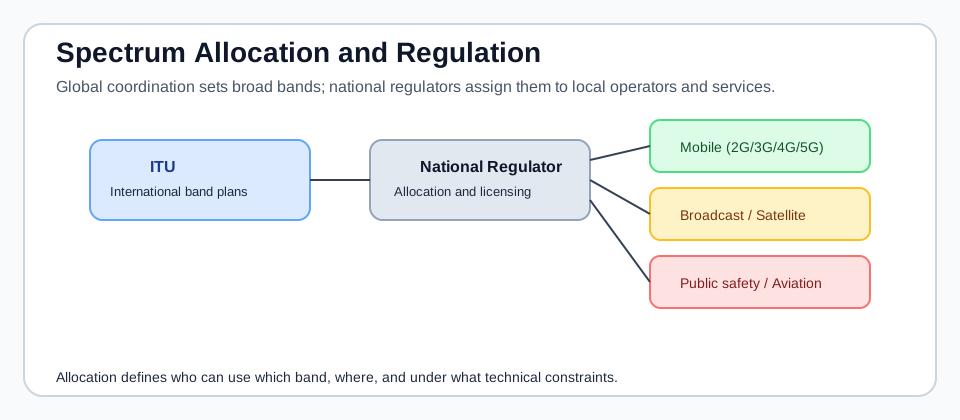 Regulatory hierarchy: ITU sets global table → national regulator allocates band uses → licensor assigns specific frequencies to operators.
The International Telecommunication Union (ITU) is the United Nations agency for telecommunications. Its Radio Regulations define the global frequency allocation table — which bands are permitted for which services (mobile, broadcasting, satellite, aeronautical, etc.) worldwide.
Exam point: ITU coordinates global spectrum. India is in ITU Region 3. WRC is held every 3–4 years to update the global frequency allocation table.
In India, spectrum management involves three bodies:
| Body | Full name | Role |
|---|---|---|
| WPC | Wireless Planning and Coordination Wing | Main government body for spectrum planning and licensing. Under Ministry of Communications. |
| TRAI | Telecom Regulatory Authority of India | Recommends spectrum pricing, auction design, and usage conditions |
| DoT | Department of Telecommunications | Final authority; conducts auctions and issues licences |
Exam point: WPC (Wireless Planning & Coordination) is the national frequency management authority in India. It issues licences and coordinates with ITU.
These three terms have distinct meanings and are often confused in exam questions:
| Term | Meaning | Example |
|---|---|---|
| Allocation | Designating a band for a category of service (global/national level) | "700 MHz band allocated for IMT (mobile)" |
| Assignment | Designating a specific frequency to a specific operator in a specific area | "Assigning 700 MHz block to Operator X in Circle Y" |
| Licensing | Legal authorisation granted to an operator to use an assigned frequency | "Spectrum Licence for 10 MHz × 2 in Band A" |
| Model | Who can use it | Examples |
|---|---|---|
| Licensed (exclusive) | Named operator only, in a defined area | Mobile operators — 900 MHz, 1800 MHz, 2100 MHz |
| Unlicensed (licence-exempt) | Anyone within power limits | Wi-Fi (2.4/5/6 GHz), Bluetooth, Zigbee |
| Shared / Shared Licensed | Multiple users by rule or sensing | CBRS band (USA), some satellite-terrestrial shares |
Exam point: Wi-Fi operates in unlicensed spectrum — anyone can use 2.4 GHz or 5 GHz without a licence, provided they follow transmit power limits.
The Indian government auctions spectrum to telecom operators. Operators bid for blocks of spectrum; the highest bidder wins a licence for a defined period (typically 20 years).
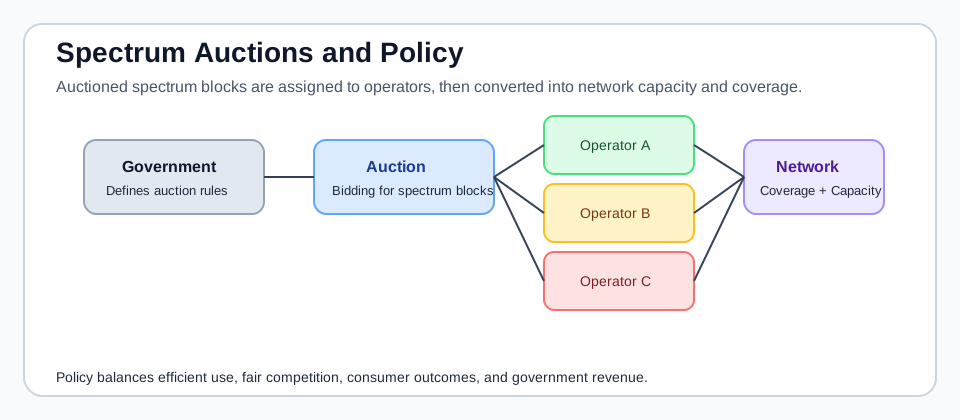 Auction flow: government defines the rules and reserve price → operators bid → winner pays and receives a licensed block.
Key facts about Indian spectrum auctions:
Exam point: India has 22 licensed service areas (telecom circles) for spectrum. BSNL has spectrum allocated in multiple bands across these circles.
Frequency reuse is the practice of using the same frequency band in non-adjacent cells of a cellular network. Because radio signals weaken with distance, the same frequencies can be reused at a safe geographic separation without causing harmful interference.
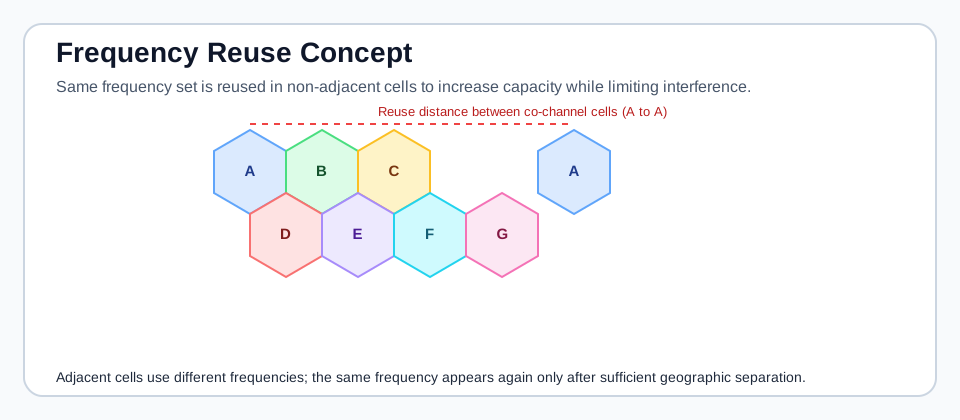 Same-frequency cells (marked with the same number) are spaced far enough apart that co-channel interference is kept below an acceptable threshold.
Key concepts:
Exam point: Smaller cells (microcells, picocells) reuse spectrum more aggressively, increasing network capacity in dense areas — this is the basis of cell splitting.
Interference is unwanted energy that degrades a signal. Two types are commonly tested:
| Type | Cause | Management |
|---|---|---|
| Co-channel Interference (CCI) | Another transmitter using the exact same frequency | Increase reuse distance, power control, directional antennas |
| Adjacent Channel Interference (ACI) | Leakage from a transmitter on a neighboring frequency | Guard bands, sharp band-pass filters, power control |
Interference mitigation techniques:
Exam point: Cell towers use sectorisation (typically 3 sectors per site) to reduce co-channel interference within the cluster and increase capacity.
As operators deploy 5G, they cannot immediately clear all 4G users from a band. Dynamic Spectrum Sharing (DSS) allows 4G and 5G to share the same frequency block simultaneously, with the network dynamically allocating subcarriers to each technology based on demand.
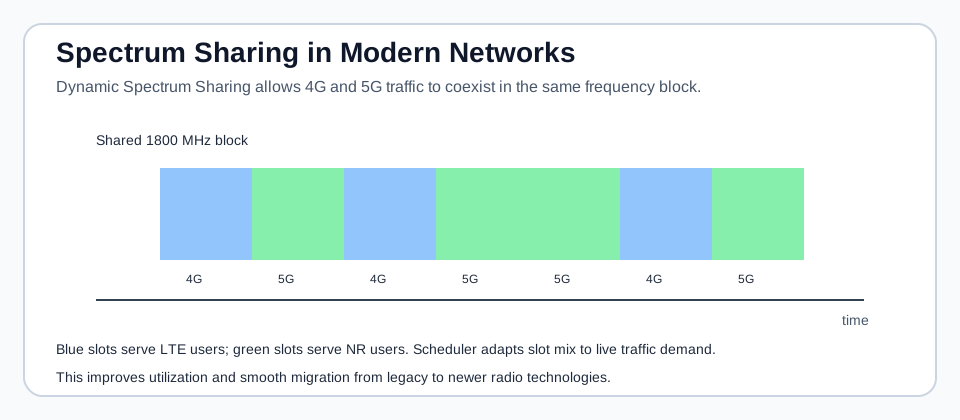 DSS: in each OFDM frame, some subcarriers carry LTE traffic and others carry NR (5G) traffic. The split changes dynamically with load.
| Sharing type | How it works | Example |
|---|---|---|
| DSS (Dynamic Spectrum Sharing) | 4G and 5G NR share same band per frame | Operators rolling out 5G on existing 4G bands |
| Licensed Shared Access (LSA) | Primary and secondary users share under strict rules | Defence band shared with mobile operator |
| Unlicensed coexistence | Devices sense the channel before transmitting | Wi-Fi (CSMA/CA), LTE-U, NR-U in 5/6 GHz |
Exam point: DSS (Dynamic Spectrum Sharing) is the key technology that lets operators launch 5G services quickly on their existing 4G spectrum without waiting to clear the band.
| Band | Frequency | Generation / Technology | Notes |
|---|---|---|---|
| 700 MHz | 703–748 / 758–803 MHz | 4G LTE, 5G | Best indoor coverage; propagates farthest |
| 800 MHz | 824–849 / 869–894 MHz | CDMA / 4G | |
| 900 MHz | 890–915 / 935–960 MHz | 2G GSM, 4G refarm | Original GSM band in India |
| 1800 MHz | 1710–1785 / 1805–1880 MHz | 2G GSM, 4G LTE | Most widely refarmed band |
| 2100 MHz | 1920–1980 / 2110–2170 MHz | 3G WCDMA, 4G | Primary 3G band |
| 2300 MHz | 2300–2400 MHz (TDD) | 4G LTE TDD | BWA band auction 2010 |
| 2500 MHz | 2500–2690 MHz (TDD) | 4G LTE TDD, 5G | |
| 3.5 GHz | 3300–3670 MHz | 5G NR (mid-band) | Primary 5G band globally |
| 26 GHz | 24.25–27.5 GHz | 5G NR (mmWave) | High capacity, short range |
| 2.4 GHz | 2400–2483.5 MHz | Wi-Fi (unlicensed) | 802.11b/g/n |
| 5 GHz | 5150–5875 MHz | Wi-Fi (unlicensed) | 802.11a/n/ac |
| C-band | 4–8 GHz | Satellite (FSS) | VSAT, DTH feeder |
| Ku-band | 12–18 GHz | Satellite (FSS/BSS) | DTH broadcast |
| Topic | Remember this |
|---|---|
| ITU role | Global spectrum coordination and frequency allocation table |
| India's ITU region | Region 3 |
| WPC full form | Wireless Planning and Coordination Wing |
| WPC role | National frequency management and licensing body in India |
| TRAI role | Recommends spectrum pricing and auction design |
| Number of telecom circles in India | 22 |
| Spectrum for voice calls (GSM) | 900 MHz and 1800 MHz |
| Primary 3G band | 2100 MHz (WCDMA) |
| Primary 5G mid-band | 3.5 GHz (3300–3670 MHz) |
| Wi-Fi bands | 2.4 GHz and 5 GHz (unlicensed) |
| Unlicensed spectrum | No licence needed; must follow power limits |
| Licensed spectrum | Exclusive rights; obtained by auction or administrative assignment |
| Co-channel interference | Same frequency in nearby cells |
| Adjacent channel interference | Leakage from adjacent frequency slot |
| Guard band purpose | Prevent adjacent channel interference |
| Cell cluster size N | Number of cells sharing the full frequency set |
| DSS | Dynamic Spectrum Sharing — lets 4G and 5G coexist in same band |
| Frequency reuse benefit | Allows same spectrum to serve multiple cells → higher capacity |
| Lower frequency advantage | Better range, better building penetration |
| Higher frequency advantage | More bandwidth available |
