Free chapter for students preparing for BSNL SET.
Multiplexing Techniques
Multiplexing is the technique of combining multiple independent signals or data streams onto a single shared communication link simultaneously. It is fundamental to telecom — without it, every phone call would need its own dedicated wire or radio channel between the two endpoints.
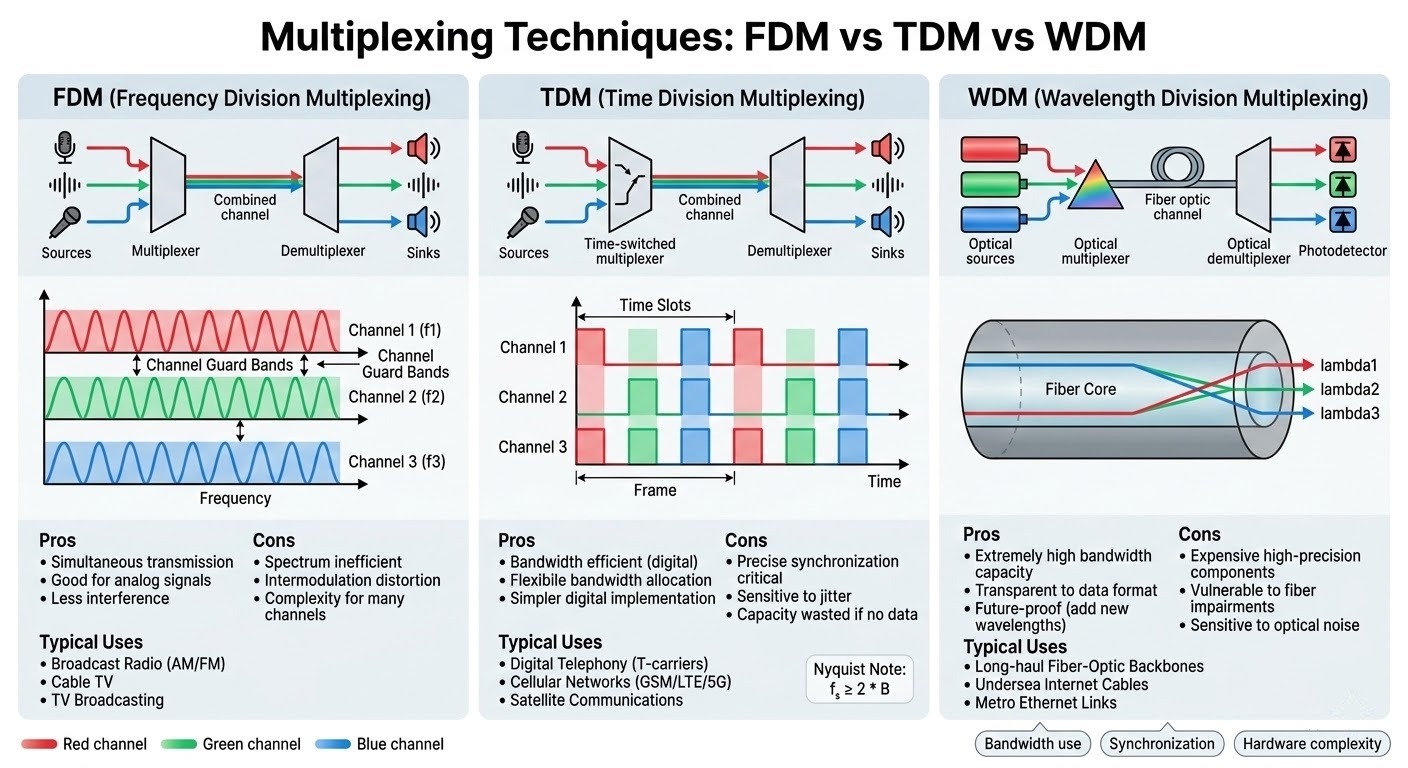 Side-by-side comparison of FDM (frequency slots), TDM (time slots), and WDM (wavelength channels) multiplexing.
1. Why Multiplexing?
- Cost: Laying a separate cable for every user is far too expensive. Multiplexing lets hundreds or thousands of users share one cable or radio link.
- Efficiency: A single long-distance fiber can carry billions of bits per second — multiplexing fills that capacity with many users' traffic.
- Manageability: A single high-capacity link is easier to manage, monitor, and upgrade than thousands of individual connections.
Exam point: Multiplexing is the reason a single telephone exchange port or fiber backbone can serve thousands of simultaneous calls.
2. Frequency Division Multiplexing (FDM)
FDM divides the available frequency spectrum into separate non-overlapping frequency bands (channels). Each user is permanently assigned one band and can transmit continuously within it.
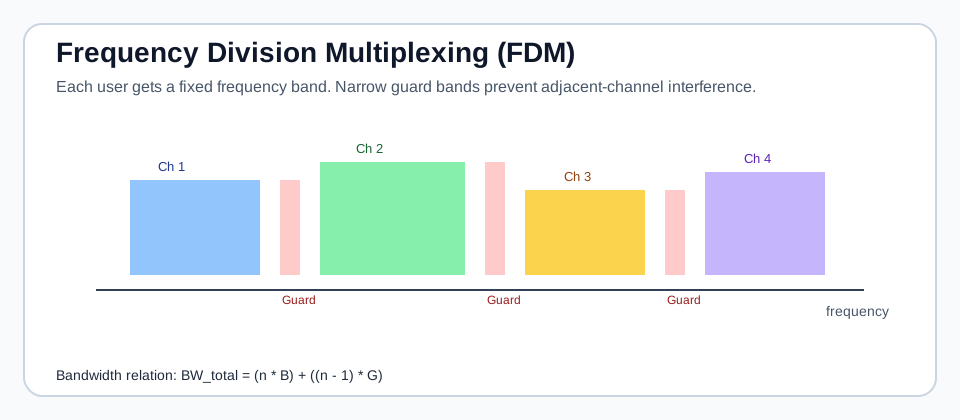 FDM spectrum view: each user gets a dedicated frequency slot. Guard bands between slots prevent adjacent-channel interference.
Key facts:
- Analog technique (used with analog signals)
- Each user gets a fixed portion of the bandwidth — whether they are transmitting or not
- Guard bands: Small unused frequency gaps are placed between adjacent channels to prevent interference
- If a user is idle, their frequency band is wasted
- Used in: AM/FM radio broadcasting, analog telephone trunk lines (PSTN), cable TV (CATV), first-generation (1G) mobile networks (FDMA)
Guard bands are mandatory in FDM. Without them, the edges of adjacent channels would overlap — this is called adjacent channel interference (ACI).
Exam point: FDM is an analog technique. Guard bands are needed to prevent interference between channels. Spectrum is wasted when users are idle.
3. Time Division Multiplexing (TDM)
TDM divides the transmission channel by time. All users share the full bandwidth but take turns — each user is allocated a fixed repeating time slot. One complete cycle of slots across all users is called a frame.
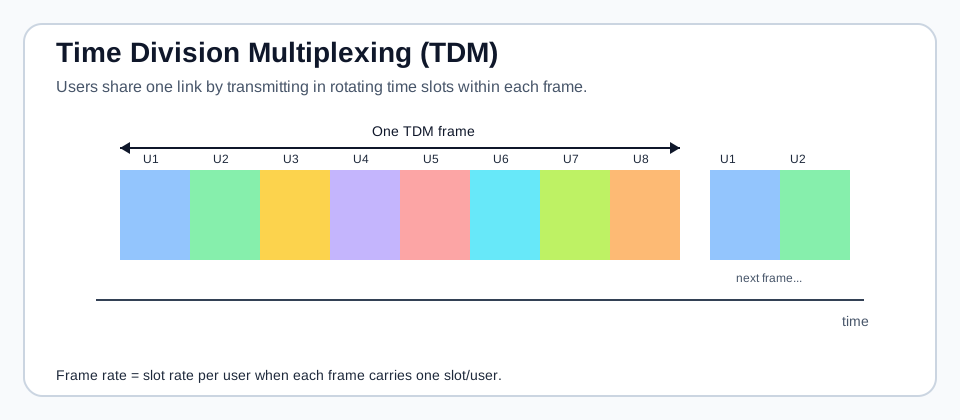 TDM timeline: users are interleaved in fixed time slots within each repeating frame. Every user gets one slot per frame.
Key facts:
- Digital technique (used with digital signals)
- Each user gets the full bandwidth, but only for their allotted time slot
- All users' slots are always reserved — even if a user has nothing to send (fixed TDM)
- Synchronization is critical — sender and receiver must agree on the frame structure
- Used in: E1/T1 lines, SONET/SDH, ISDN
TDM in Practice — E1 Line
The E1 line (the standard in India/Europe) is a classic TDM system:
| E1 Property |
Value |
| Total bit rate |
2.048 Mbps |
| Number of time slots |
32 per frame |
| Voice channels (traffic) |
30 |
| Signaling channel |
Slot 16 |
| Framing/sync channel |
Slot 0 |
| Bit rate per slot |
64 kbps |
| Frame duration |
125 µs (8,000 frames/sec) |
Exam point: E1 = 2.048 Mbps = 32 time slots × 64 kbps. It carries 30 voice + 1 signaling + 1 framing channel. This is a very commonly tested fact.
Synchronous vs Asynchronous TDM
| Type |
Slots assignment |
Efficiency |
Example |
| Synchronous (fixed) TDM |
Fixed; each user always has a slot |
Can waste capacity when idle |
E1, SONET |
| Asynchronous (statistical) TDM |
Dynamic; only active users get slots |
Efficient; no wasted slots |
Packet networks |
4. Statistical Multiplexing
In Statistical Multiplexing, time slots are not pre-assigned. Slots are dynamically allocated only to users who have data to send. If a user is silent, no slot is wasted — another user gets it.
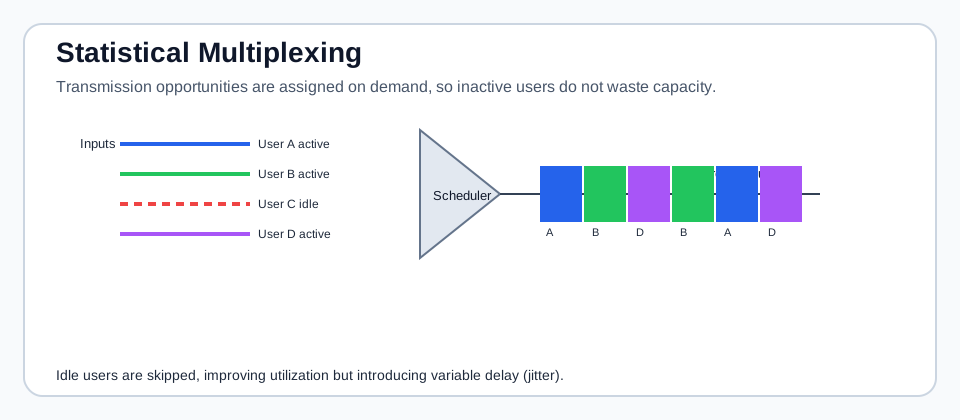 Only active users consume link capacity. Idle users release their slot instantly — so many more users can share the link.
Key facts:
- More efficient than fixed TDM — higher average link utilization
- Introduces variable delay (jitter) — different packets may wait different amounts of time
- Requires buffers to hold packets when the link is busy
- The foundation of packet-switched networks (Internet, IP networks)
- Works on the statistical reality that most users are not active at the exact same instant
Exam point: Statistical multiplexing is the basis of the Internet. It trades predictable latency (fixed TDM) for higher efficiency. Jitter is an inherent side-effect.
5. Wavelength Division Multiplexing (WDM)
WDM is essentially FDM applied to optical fiber. Different data streams are transmitted on the same fiber using different wavelengths (colors) of light. A wavelength in WDM is often called a lambda (λ) or channel.
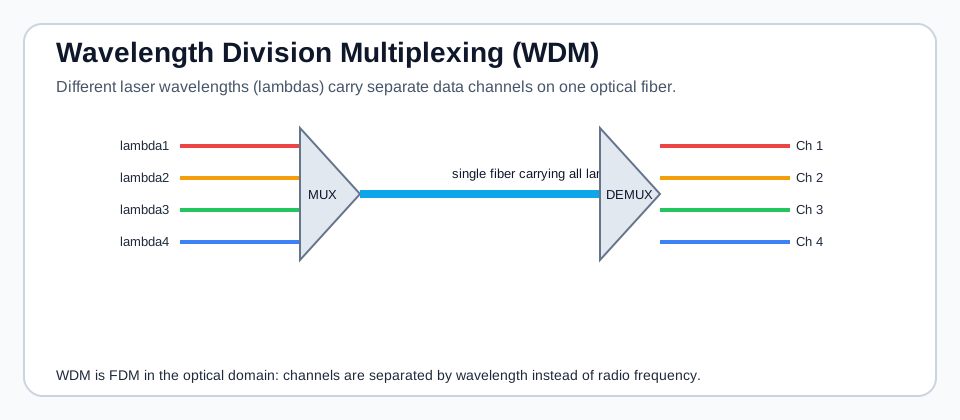 WDM: multiple wavelengths enter a multiplexer, travel down one fiber, and are separated by a demultiplexer at the far end.
Key facts:
- Works only on optical fiber (not copper)
- The multiplexer at the transmit end combines all wavelengths onto one fiber
- The demultiplexer at the receive end separates them back
- Each wavelength is completely independent — can carry different data rates or protocols
WDM Variants
| Variant |
Wavelength spacing |
Channels |
Use |
| CWDM (Coarse WDM) |
Wide (~20 nm) |
8–18 |
Metro networks, shorter distances |
| DWDM (Dense WDM) |
Very narrow (~0.8 nm) |
40–160+ |
Long-haul backbone, BSNL national network |
Exam point: DWDM is used in long-haul backbone networks (including BSNL's national backbone). It can carry 40–160+ channels on a single fiber, each at 10–100 Gbps. DWDM dramatically reduces the cost per bit of long-distance transmission.
Total capacity of a DWDM system:
If a fiber carries 80 DWDM channels each at 100 Gbps → total capacity = 80 × 100 = 8 Tbps on one fiber.
6. Code Division Multiplexing (CDM) / CDMA
CDM allows multiple users to transmit simultaneously on the same frequency band at the same time. Users are separated by unique mathematical codes (called spreading codes or chip codes). Each receiver uses the same code as the intended transmitter to extract the correct signal.
Key facts:
- Used in CDMA (Code Division Multiple Access) mobile networks (IS-95, 3G/WCDMA)
- Every user occupies the entire bandwidth all the time — no frequency or time division
- Requires precise power control — if one user transmits too strongly, it drowns out others (near-far problem)
- Provides inherent security (a user without the code cannot decode the signal)
- Resistant to narrowband interference and multipath
Exam point: CDMA separates users by code, not frequency or time. 3G mobile networks (WCDMA) use CDMA. The near-far problem is a key challenge in CDMA systems.
7. OFDMA — Multiplexing in 4G/5G
OFDMA (Orthogonal Frequency Division Multiple Access) is the multiple-access version of OFDM. It divides the available bandwidth into many narrow subcarriers, and different users are assigned different subsets of subcarriers dynamically.
Key difference from FDM:
- FDM: fixed frequency slots, analog, guard bands needed
- OFDMA: small digital orthogonal subcarriers, no guard bands needed, dynamic assignment per frame
| System |
Multiple Access |
What it divides |
| 1G (analog) |
FDMA |
Frequency |
| 2G (GSM) |
TDMA + FDMA |
Time + Frequency |
| 3G (WCDMA) |
CDMA (WCDMA) |
Code |
| 4G (LTE) downlink |
OFDMA |
Subcarriers |
| 4G (LTE) uplink |
SC-FDMA |
Subcarriers (single-carrier) |
| 5G NR |
OFDMA |
Subcarriers (flexible numerology) |
Exam point: The progression from FDMA → TDMA → CDMA → OFDMA maps directly to 1G → 2G → 3G → 4G. This table is high-yield for MCQs.
8. Multiplexing Techniques — Master Comparison
| Feature |
FDM |
TDM |
WDM |
CDM |
Statistical MUX |
| Resource divided |
Frequency |
Time |
Wavelength (light) |
Code |
Time (dynamic) |
| Signal type |
Analog |
Digital |
Optical |
Digital |
Digital |
| Guard bands needed? |
Yes |
No |
No (wavelength spacing) |
No |
No |
| Idle capacity wasted? |
Yes |
Yes (fixed TDM) |
Yes |
No |
No |
| Delay type |
Constant |
Constant |
Constant |
Variable (power dep.) |
Variable (jitter) |
| Example use |
FM radio, 1G |
E1, SONET, GSM |
Fiber backbone |
3G WCDMA |
Internet/IP |
9. Key Numbers for the Exam
| Fact |
Value |
| E1 bit rate |
2.048 Mbps |
| E1 time slots |
32 (30 voice + 1 signaling + 1 framing) |
| E1 bit rate per slot |
64 kbps |
| E1 frame rate |
8,000 frames/second |
| T1 bit rate (North America) |
1.544 Mbps (24 channels × 64 kbps) |
| STM-1 (SDH) |
155.52 Mbps (E1 × 63) |
| DWDM typical channels |
40–160 per fiber |
| DWDM channel spacing (ITU-T) |
100 GHz or 50 GHz |
10. Quick Revision — Key Facts for the Exam
| Topic |
Remember this |
| FDM resource |
Frequency band |
| TDM resource |
Time slot |
| WDM resource |
Wavelength (lambda) |
| CDM resource |
Spreading code |
| FDM guard bands |
Needed — prevent adjacent channel interference |
| FDM signal type |
Analog |
| TDM signal type |
Digital |
| E1 total bit rate |
2.048 Mbps |
| E1 voice channels |
30 (out of 32 slots) |
| WDM medium |
Optical fiber only |
| DWDM use |
Long-haul backbone, national networks |
| Statistical MUX drawback |
Variable delay / jitter |
| CDMA separates users by |
Unique spreading codes |
| LTE downlink multiple access |
OFDMA |
| LTE uplink multiple access |
SC-FDMA |
| Near-far problem |
CDMA challenge — strong nearby signal drowns weak distant one |
| 1G multiple access |
FDMA |
| 2G (GSM) multiple access |
TDMA + FDMA |
| 3G multiple access |
CDMA (WCDMA) |
| 4G multiple access |
OFDMA |
11. Practice Questions
- What does FDM stand for and what resource does it divide?
- What is a guard band and why is it needed in FDM?
- How many voice channels does an E1 line carry?
- What is the total bit rate of an E1 line?
- What is the difference between synchronous TDM and statistical multiplexing?
- Why is WDM only used with optical fiber and not copper cables?
- What is DWDM and where is it used?
- How does CDM/CDMA separate users?
- What is the near-far problem in CDMA?
- List the multiple access technology used in each mobile generation (1G to 4G).
- What is the disadvantage of statistical multiplexing compared to fixed TDM?
- If a DWDM system has 40 channels each carrying 10 Gbps, what is the total capacity?
- Frequency Division Multiplexing — it divides the available frequency spectrum into separate non-overlapping bands.
- A guard band is a small unused frequency gap between adjacent FDM channels. It prevents the signal edges of neighboring channels from overlapping and causing interference.
- 30 voice channels (32 total slots minus 1 framing and 1 signaling slot).
- 2.048 Mbps.
- Synchronous TDM pre-assigns fixed time slots to every user — slots are reserved even when the user is idle. Statistical multiplexing assigns slots dynamically only to users with data to send, wasting no capacity but introducing variable delay.
- WDM uses different wavelengths (colors) of light on optical fiber. Copper cables carry electrical signals, which cannot be multiplexed by wavelength.
- Dense Wavelength Division Multiplexing — packs 40 to 160+ closely-spaced optical wavelengths onto one fiber. Used in long-haul backbone and national networks (including BSNL's backbone).
- Every user is assigned a unique mathematical spreading code. Multiple users transmit simultaneously on the same frequency; the receiver applies the matching code to extract only the intended signal.
- A nearby transmitter's strong signal can overwhelm the signal from a distant transmitter at the base station, making it impossible to decode the weaker signal. Solved by tight power control.
- 1G — FDMA; 2G (GSM) — TDMA+FDMA; 3G (WCDMA) — CDMA; 4G (LTE) — OFDMA.
- Statistical multiplexing introduces variable delay (jitter), whereas fixed TDM provides constant, predictable delay — important for real-time traffic like voice.
- 40 × 10 Gbps = 400 Gbps.
