BSNL SET Telecom Notes
Free chapter for students preparing for BSNL SET.
Modulation is the process of varying one property of a high-frequency carrier signal (amplitude, frequency, or phase) to carry lower-frequency information over long distances. Demodulation is the reverse — extracting the original information from the received carrier at the destination.
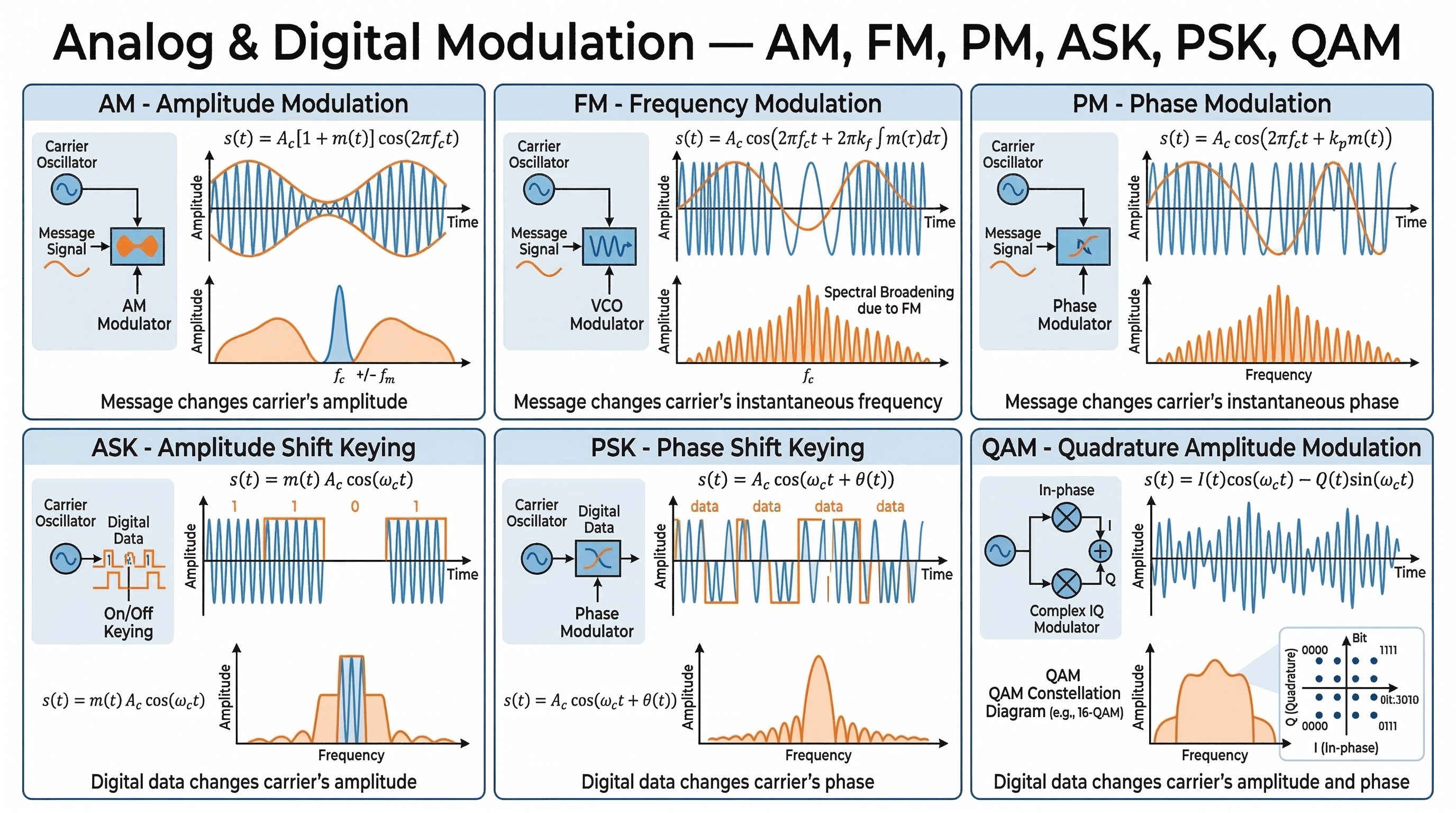 Overview of analog modulation (AM, FM, PM) and digital modulation (ASK, PSK, QAM) techniques.
Without modulation, a voice signal (300–3400 Hz) cannot be transmitted efficiently through air because:
Exam point: Modulation allows simultaneous transmission of multiple conversations over the same medium by placing each at a different carrier frequency — this is FDM (Frequency Division Multiplexing).
In analog modulation, the information (message) signal is a continuous analog waveform. The carrier is a high-frequency sine wave; modulation changes one of its three properties.
| Property Changed | Modulation Type | Abbreviation |
|---|---|---|
| Amplitude | Amplitude Modulation | AM |
| Frequency | Frequency Modulation | FM |
| Phase | Phase Modulation | PM |
The amplitude of the carrier varies in step with the message signal. The frequency and phase of the carrier stay constant.
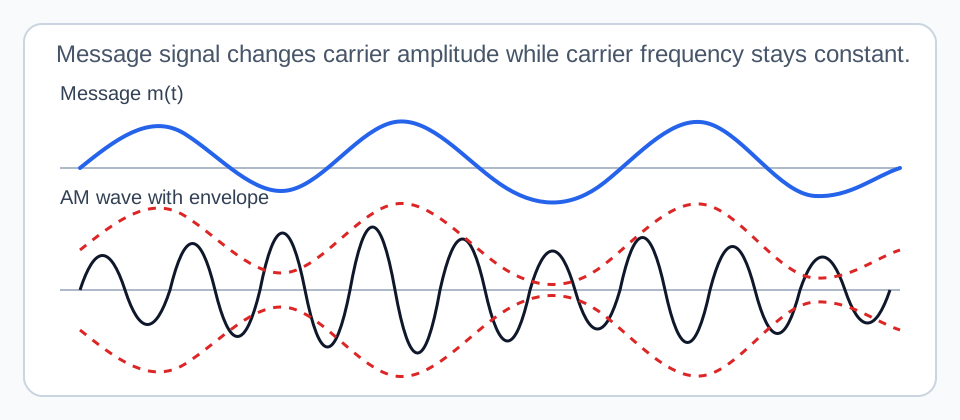 In AM, the carrier's amplitude envelope follows the shape of the message signal while the carrier frequency stays fixed.
Key facts:
Exam point: AM bandwidth = . For a 5 kHz audio signal on AM, occupied bandwidth = 10 kHz.
Variants of AM:
| Variant | Full name | What it transmits | Bandwidth | Advantage |
|---|---|---|---|---|
| DSB-FC | Double Sideband Full Carrier | Both sidebands + carrier | 2fm | Simple receiver; standard AM broadcast |
| DSB-SC | Double Sideband Suppressed Carrier | Both sidebands, no carrier | 2fm | Power efficient |
| SSB | Single Sideband | One sideband only | fm | Half the bandwidth; used in HF/military |
| VSB | Vestigial Sideband | One full + vestige of other | ~fm | Used in analog TV |
Exam point: SSB uses half the bandwidth of DSB and is power-efficient — commonly tested comparison.
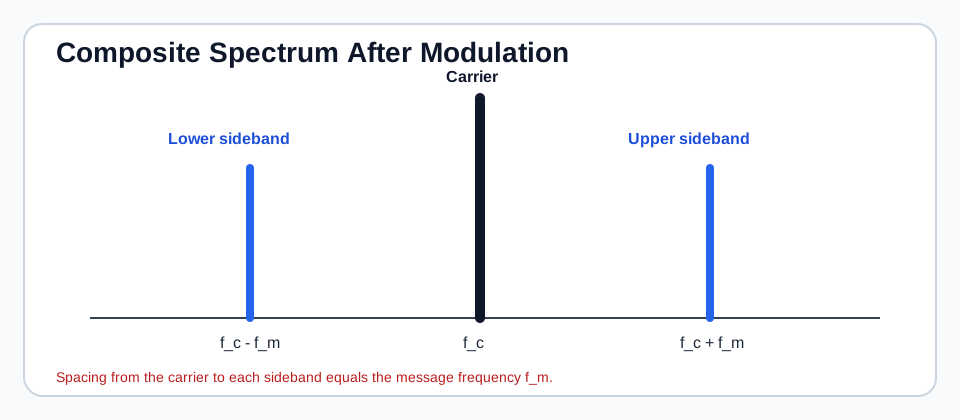 A modulated carrier creates a Lower Sideband (LSB) at fc − fm and an Upper Sideband (USB) at fc + fm. Together they determine the occupied bandwidth.
The frequency of the carrier varies in proportion to the message signal amplitude. Amplitude stays constant.
Key facts:
Exam point: FM is preferred over AM when noise immunity is critical. FM is used for high-fidelity audio (commercial FM radio).
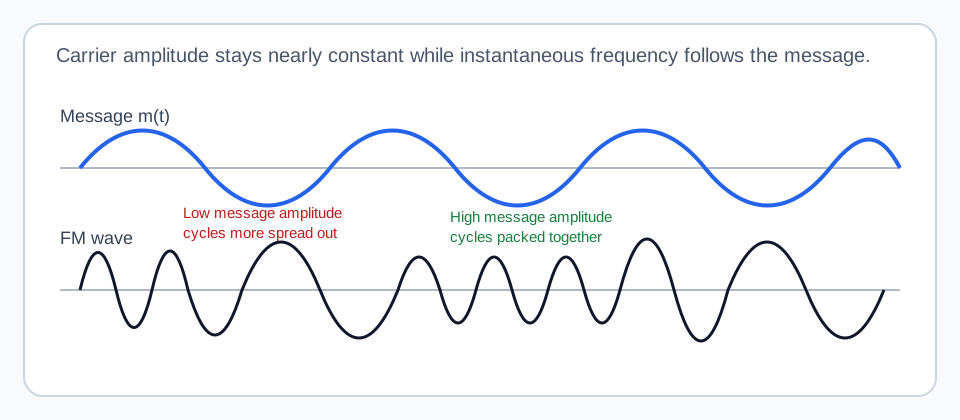 In FM, the spacing between carrier cycles (instantaneous frequency) changes with the message amplitude while the carrier amplitude stays constant.
The phase of the carrier changes with the message signal. PM and FM are mathematically related — a changing phase also instantaneously changes frequency.
Key facts:
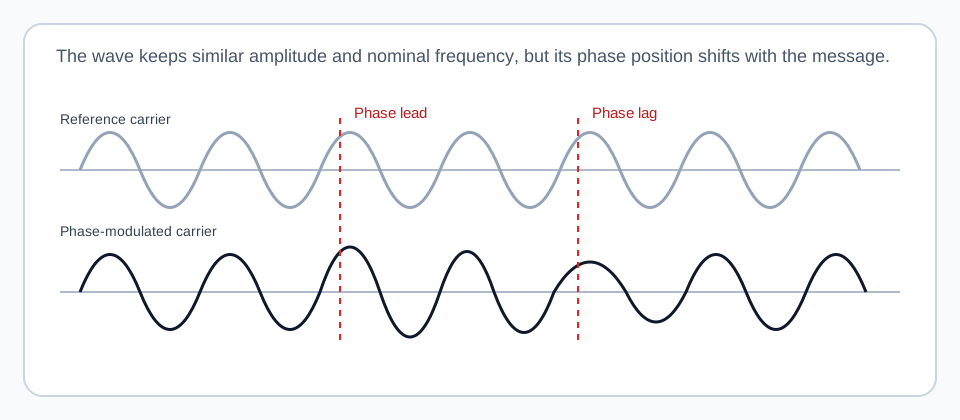 In PM, the phase of the carrier shifts in proportion to the message signal value, producing visible leading and lagging relative to a reference carrier.
| Property | AM | FM |
|---|---|---|
| What changes | Amplitude | Frequency |
| Amplitude constant? | No | Yes |
| Noise immunity | Low (noise hits amplitude) | High (noise ignores frequency) |
| Bandwidth | 2fm (narrow) | 2(Δf + fm) (wider) |
| Circuit complexity | Simple | More complex |
| Power efficiency | Low (power wasted in carrier) | Better |
| Typical use | MW/SW radio, aviation | FM radio, VHF links |
In digital modulation, the message is a digital bitstream (0s and 1s). The carrier's amplitude, frequency, or phase is switched between discrete states, one per symbol.
Symbol vs Bit:
The carrier amplitude switches between values to represent bits. Simple but highly susceptible to noise. Used in optical fiber (on/off keying is a form of ASK) and RFID.
The carrier frequency switches between values. More noise-resistant than ASK. Used in older modems, caller-ID, paging systems. BFSK (Binary FSK) uses two frequencies for 0 and 1.
The carrier phase switches between values. Better spectral efficiency than FSK.
| PSK Type | States (M) | Bits/Symbol | Use |
|---|---|---|---|
| BPSK | 2 | 1 | Satellite links, deep-space; most robust |
| QPSK | 4 | 2 | 3G (WCDMA), satellite; good balance |
| 8-PSK | 8 | 3 | DVB-S2, some microwave links |
Exam point: BPSK carries 1 bit/symbol; QPSK carries 2 bits/symbol. QPSK is twice as spectrally efficient as BPSK at the same symbol rate.
QAM combines both amplitude and phase changes, producing a large number of distinct symbols. Each symbol represents multiple bits, enabling very high data rates.
| QAM Order | States (M) | Bits/Symbol | Typical use |
|---|---|---|---|
| 16-QAM | 16 | 4 | LTE, Wi-Fi (802.11) |
| 64-QAM | 64 | 6 | LTE, DOCSIS cable |
| 256-QAM | 256 | 8 | LTE-Advanced, 5G, cable broadband |
| 1024-QAM | 1024 | 10 | 5G NR (good channel conditions) |
Exam point: Higher-order QAM carries more bits per symbol but needs a cleaner (higher SNR) channel. 64-QAM needs a better signal than 16-QAM to work reliably.
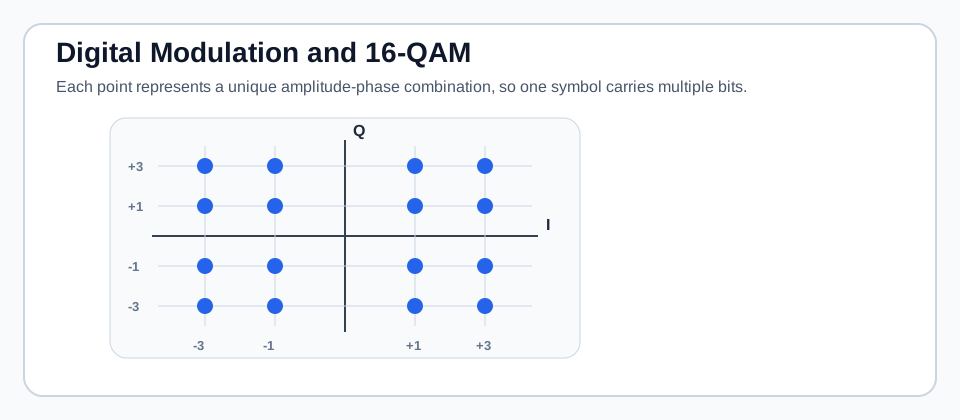 A QAM constellation maps each symbol to an (in-phase, quadrature) point. 16-QAM has 16 points — each carrying 4 bits. More points = more bits per symbol = higher SNR required.
A special form of FSK where transitions are smoothed using a Gaussian filter. Produces a compact spectrum. Used in GSM (2G) networks.
Exam point: GSM uses GMSK modulation. GMSK is efficient and compact, ideal for mobile channels.
OFDM is not a single modulation scheme but a multi-carrier transmission method. A high-speed data stream is split into many parallel slower streams, each modulated onto a closely spaced subcarrier.
How it works:
Why OFDM is powerful:
| Standard | OFDM variant |
|---|---|
| LTE (4G) downlink | OFDMA (OFDM + multiple access) |
| LTE (4G) uplink | SC-FDMA (single-carrier variant) |
| 5G NR | OFDM with numerology (variable subcarrier spacing) |
| Wi-Fi (802.11a/g/n/ac/ax) | OFDM / OFDMA |
| DVB-T (digital TV) | OFDM |
Exam point: LTE uses OFDMA for downlink (base station to phone) and SC-FDMA for uplink (phone to base station). 5G NR also uses OFDM.
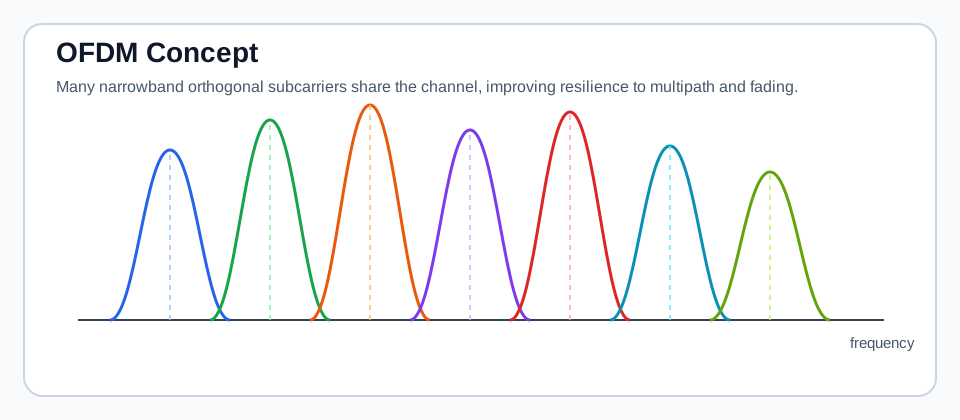 OFDM packs many narrow orthogonal subcarriers tightly together. Each subcarrier carries a low-speed stream (QPSK or QAM), but combined they deliver very high aggregate throughput.
Demodulation is the receiver-side process of recovering the original message from the received modulated signal.
| Modulation | Demodulation method |
|---|---|
| AM | Envelope detector (non-coherent) or synchronous detector (coherent) |
| FM | Discriminator / limiter-discriminator, PLL demodulator |
| PM | Phase detector / Costas loop |
| PSK / QAM | Coherent detector (requires carrier recovery and synchronization) |
| Feature | Coherent | Non-Coherent |
|---|---|---|
| Phase synchronization required? | Yes | No |
| Performance (BER) | Better (lower error rate) | Worse (higher error rate) |
| Circuit complexity | High | Low |
| Examples | BPSK, QPSK, QAM | BFSK, ASK envelope detector |
Exam point: Coherent detection gives better performance but is more complex. Non-coherent detection is simpler but less accurate.
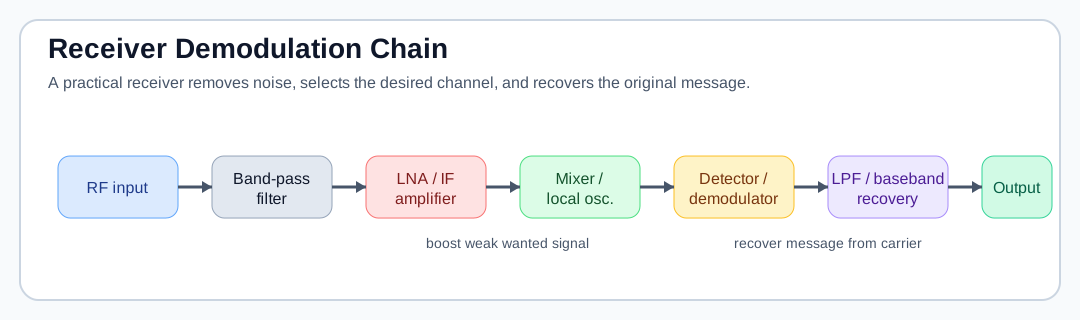 A typical receiver: RF front-end selects the channel → amplifies → down-converts to baseband → demodulates → recovers the original message signal.
| System | Modulation used |
|---|---|
| AM radio (MW/SW) | AM (DSB-FC) |
| FM radio | FM |
| GSM (2G) | GMSK |
| CDMA (3G) / WCDMA | QPSK (data), BPSK (control) |
| LTE (4G) downlink | OFDMA (with QPSK, 16-QAM, 64-QAM) |
| LTE (4G) uplink | SC-FDMA |
| 5G NR | OFDM (with up to 256-QAM or 1024-QAM) |
| Wi-Fi (802.11ac/ax) | OFDM (up to 256-QAM / 1024-QAM) |
| Satellite (broadband) | BPSK, QPSK, 8-PSK, 16-APSK |
| Optical fiber (coherent) | DP-QPSK, 16-QAM |
| Formula | What it gives |
|---|---|
| Bandwidth of an AM signal | |
| Bandwidth of an FM signal (Carson's Rule) | |
| FM modulation index | |
| Bits carried per symbol for M-ary modulation | |
| Bit rate from symbol rate |
| Topic | Remember this |
|---|---|
| AM changes | Amplitude of carrier |
| FM changes | Frequency of carrier |
| PM changes | Phase of carrier |
| AM noise immunity | Low (noise affects amplitude) |
| FM noise immunity | High (noise does not affect frequency) |
| AM bandwidth | 2fm |
| FM bandwidth (Carson's) | 2(Δf + fm) |
| SSB advantage | Half the bandwidth of DSB |
| BPSK bits/symbol | 1 |
| QPSK bits/symbol | 2 |
| 16-QAM bits/symbol | 4 |
| 64-QAM bits/symbol | 6 |
| 256-QAM bits/symbol | 8 |
| GSM modulation | GMSK |
| LTE downlink multiple access | OFDMA |
| LTE uplink multiple access | SC-FDMA |
| OFDM strength | Multipath resistance, spectral efficiency |
| Coherent detection | Better BER; needs phase sync |
| Non-coherent detection | Simpler; higher BER |
