
Exam Guide
UPSC vs SSC CGL vs State PSC - Which Government Exam Should You Choose in 2026?
UPSC vs SSC CGL vs State PSC - Which Government Exam Is Right For You?
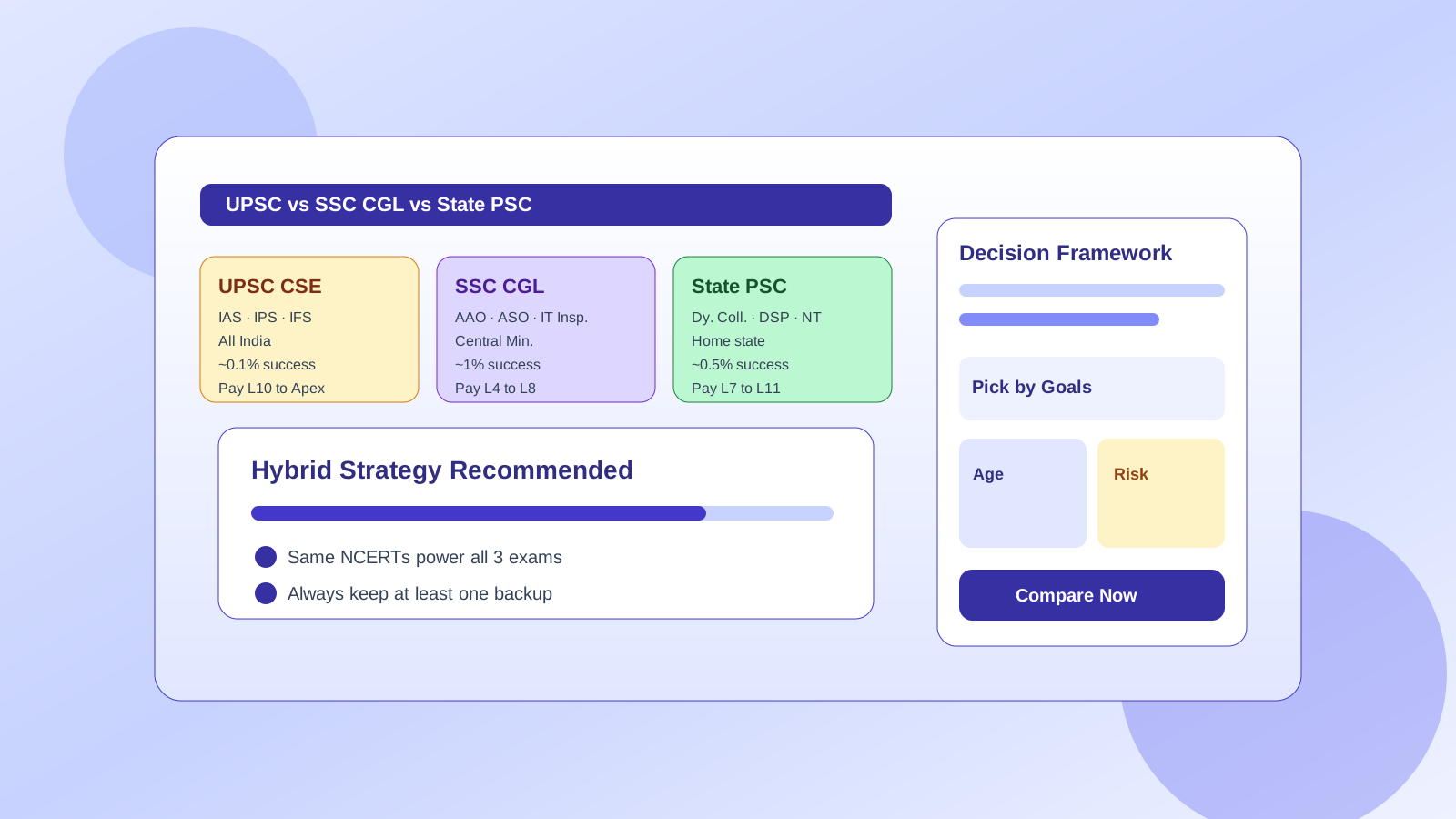
This is the single most common question new graduates ask: "Should I prepare for UPSC, or SSC CGL, or my State PSC?" The honest answer is - it depends on your age, background, risk appetite and life goals. This guide breaks down the three exam tracks side-by-side and ends with a decision framework you can actually apply this weekend.
1. The Three Exams in One Line Each
- UPSC Civil Services Exam (CSE) - the all-India recruitment for IAS, IPS, IFS and 20+ other Group A and B services. Hardest, longest, highest payoff.
- SSC Combined Graduate Level (CGL) - central recruitment for Group B and C posts in Ministries (Income Tax Inspector, ASO, Auditor, AAO, JSO etc.). Most accessible, fastest cycle.
- State Public Service Commission (PSC) exams (MPPSC, BPSC, UPPSC, RAS, MPSC, KPSC, TNPSC etc.) - state-level recruitment for State Civil Services and equivalents (Deputy Collector, DSP, Tehsildar). Middle ground - slightly easier than UPSC, slightly higher prestige than SSC, but limited to one state.
2. Quick Comparison Table
| Parameter | UPSC CSE | SSC CGL | State PSC (typical) |
|---|---|---|---|
| Conducting body | UPSC | SSC | State PSCs (MPPSC, BPSC etc.) |
| Cycle length | 15 to 16 months | 8 to 10 months | 12 to 15 months |
| Typical vacancies / year | 800 to 1,100 | 17,000 to 20,000 | 200 to 700 per state |
| Applicants / year | 10 to 12 lakh | 30 to 40 lakh | 3 to 8 lakh per state |
| Success rate | ~0.1 to 0.2% | ~1 to 3% | ~0.5 to 1% |
| Stages | Prelims + Mains + Interview | Tier-1 + Tier-2 | Prelims + Mains + Interview |
| Mains type | Descriptive (1750 marks) | Objective + descriptive | Descriptive (state-specific) |
| Optional subject | Yes - 500 marks | No | Most states no, some yes |
| Age limit (UR) | 21 to 32 years | 18 to 30 / 32 years (post-wise) | 21 to 35 / 40 years |
| Attempts (UR) | 6 | Unlimited (within age) | Unlimited (within age) |
| Top post | IAS / IPS / IFS | AAO / Inspector IT / ASO MEA | Deputy Collector / DSP |
| Entry pay level | Level 10 (₹56,100) | Level 4 to 8 (₹25,500 to 47,600) | Level 7 to 11 (₹44,900 to 56,100) |
| Postings | All-India | All-India (post specific) | One state only |
| Promotion ceiling | Cabinet Secretary (Level 17) | Director / Senior AO | Chief Secretary (after IAS promotion) |
| Coaching dependence | Medium (self-study viable) | Low (self-study sufficient) | Medium (state-specific) |
| Exam medium | English / Hindi / Indian languages | English / Hindi | Mostly state language + Hindi / English |
3. Eligibility - Who Can Apply for What
Educational Qualification
- UPSC CSE: Bachelor's degree in any discipline from a recognised university. No minimum percentage. Final-year students can apply for Prelims.
- SSC CGL: Bachelor's in any discipline. Some posts add specifics - JSO needs Math/Stats background, AAO is open to all but desirable CA/CS/MBA.
- State PSC: Bachelor's in any discipline. Some states require knowledge of the state language (e.g., Marathi for MPSC, Tamil for TNPSC, Kannada for KPSC). Madhya Pradesh and Bihar accept Hindi.
Age Limits
- UPSC CSE: 21 to 32 (UR), 35 (OBC), 37 (SC/ST), with PwBD relaxation up to 47.
- SSC CGL: 18 to 30 / 32 depending on post; with category relaxation up to 45.
- State PSC: typically 21 to 35 (UR) for state-domicile candidates, 21 to 40 in many states (MP, Bihar, Rajasthan), with category relaxation up to 45.
Attempts
- UPSC has the strictest cap - 6 attempts for UR, 9 for OBC, unlimited for SC/ST (within age).
- SSC and State PSC have no attempt limit - apply as many times as you want until you cross the upper age limit.
4. Syllabus Overlap - You Are Not Starting from Zero
The good news: there is massive overlap between UPSC, SSC CGL and State PSC syllabi.
Topics that count in all three:
- Indian Polity (Laxmikanth covers all three).
- Modern History and Indian National Movement.
- Indian Geography + Physical Geography.
- Indian Economy fundamentals.
- General Science (Class 6 to 10 NCERT).
- Current Affairs (last 8 to 12 months).
- Logical Reasoning and Quantitative Aptitude (UPSC CSAT, SSC Tier-1, State PSC paper-2).
What is unique to each:
- UPSC - World History, World Geography, International Relations, Ethics paper, Optional subject, descriptive answer writing.
- SSC - Heavy Quant and English, no descriptive answers in Tier-1, Tier-2 Statistics or Finance & Economics for specialist posts.
- State PSC - State-specific History, Geography, Polity, Schemes, language paper.
This means you can study for all three simultaneously during the foundation phase (months 1 to 4). The branching only happens later.
5. Posts on Offer - The Career Outcome
What UPSC offers
- Top: IAS (district administration to Cabinet Secretary), IPS (DGP, Director CBI/IB), IFS (Foreign Secretary, Ambassador).
- Group A central services: IRS, IA&AS, ICAS, IPoS, IRMS etc.
- Postings: All-India - any state, any UT, any embassy.
What SSC CGL offers
- Group B Gazetted: AAO (CAG), AAccO.
- Group B non-Gazetted: ASO (CSS / MEA / IB / AFHQ / Railway), Inspector Income Tax, Inspector CBIC, SI CBI, AEO (ED), JSO.
- Group C: Auditor, Accountant, Tax Assistant, UDC.
- Postings: anywhere across central ministries; MEA postings include foreign tenures.
What State PSC offers
- Top: Deputy Collector / SDM, DSP (state cadre).
- Class I/II: Naib Tehsildar, AC State Tax, District Excise Officer, District Registrar, Treasury Officer, Cooperative AC.
- Postings: within home state only.
Promotion outlook in 25 years:
- IAS direct recruit: Joint Secretary / Additional Secretary in Government of India.
- SSC CGL Inspector IT: Assistant Commissioner of Income Tax (IRS Group A) by promotion.
- State PSC Deputy Collector: promoted to IAS via state cadre quota in 8 to 14 years.
6. Salary Comparison - Entry to Apex
| Stage | UPSC IAS | SSC AAO | SSC Inspector IT | State PSC Dy. Collector |
|---|---|---|---|---|
| Year 0 (basic) | ₹56,100 | ₹47,600 | ₹44,900 | ₹56,100 |
| Year 0 (in-hand) | ₹85,000 to ₹1,00,000 | ₹65,000 to ₹70,000 | ₹62,000 to ₹68,000 | ₹70,000 to ₹85,000 |
| Year 4 | ₹67,700 (Senior Time Scale) | progression in Audit cadre | ITO (Group B Gazetted) | ₹67,700 (state senior scale) |
| Year 16 | ₹1,44,200 (Super Time Scale) | Senior AO range | Assistant Commissioner IT (IRS A) | After IAS promotion - similar to UPSC IAS |
| Apex | ₹2,25,000 (Cabinet Secretary) | Director rank | Chief Commissioner IT | Chief Secretary (after IAS) |
Plus government accommodation (large, central locations for senior posts), official vehicle from JAG / Selection Grade onwards, CGHS, NPS pension and study leave.
7. Work, Life and Postings - The Honest Picture
UPSC IAS / IPS / IFS
- High prestige, high power, high accountability.
- 70 to 90 hour weeks at District Magistrate / SP / SDM levels.
- Frequent transfers (every 2 to 3 years).
- IFS - 3 to 4 year tenures abroad with foreign allowance.
- Family compromises - especially for spouses with their own careers.
SSC CGL Inspector / ASO / AAO
- Predictable 9-to-6 or 10-to-7 office work in most postings.
- Very limited transfers (Inspector posts often allow you to stay in your home circle).
- Excellent work-life balance compared to IAS/IPS.
- Lower public profile but solid middle-class lifestyle.
State PSC Deputy Collector / DSP
- Field-heavy work, similar intensity to IAS at the SDM/DSP level.
- Postings always within home state - good for those who want to stay close to family and culture.
- Promotion to IAS via state quota is a realistic 8 to 14 year prospect.
8. Difficulty and Success Rate - The Numbers
- UPSC CSE: ~10 lakh applicants for ~1,000 vacancies. Final selection rate ~0.1%. Average selected aspirant has spent 2 to 4 years preparing.
- SSC CGL: ~35 lakh applicants for ~17,000 vacancies. Final selection rate ~0.5 to 1% for general posts, much lower for AAO/Inspector. Average selected aspirant has prepared 1 to 2 years.
- State PSC: ~5 lakh applicants for ~500 vacancies (typical mid-size state). Final selection rate ~0.1 to 0.5%. Average selected aspirant has prepared 2 to 3 years.
The "easier" exams have lower per-post difficulty but higher absolute competition because of the sheer number of vacancies and applicants.
9. Cost and Risk Profile
- UPSC: Highest opportunity cost. 12 to 18 month full-time prep before first attempt, 4 attempts is the realistic budget. Total opportunity cost - 4 to 6 years of working life. Coaching cost -
Rs. 1.5 to 3 lakhif offline. - SSC CGL: Lowest opportunity cost. Many crack it in 8 to 12 months alongside a job. Total budget rarely exceeds
Rs. 25,000including books and online test series. - State PSC: Middle ground. State-language requirement adds an extra 3 to 6 months for non-domicile candidates.
10. The Decision Framework - Which One Is For You?
Choose UPSC CSE if you...
- Are 21 to 25 years old with at least 4 to 6 years of preparation runway.
- Want to be in the top 0.1% with a long-term policy / governance career.
- Are comfortable with descriptive writing, ethics-based reasoning and a 1750-mark Mains.
- Are willing to travel anywhere in India (or abroad) every 2 to 3 years.
- Have family / financial support for a 2 to 4 year drop year.
Choose SSC CGL if you...
- Want a government job in 8 to 12 months of preparation.
- Are strong in Math and English, or willing to become so.
- Value work-life balance over prestige.
- Are 22 to 28 years old and want a stable middle-class life with reasonable promotions.
- Are not interested in the descriptive writing or interview-based selection of UPSC.
Choose State PSC if you...
- Want to serve in your home state and stay close to family.
- Are comfortable with the state language (essential for Maharashtra, Tamil Nadu, Karnataka, Kerala, Andhra, Telangana, West Bengal).
- Are 25 to 35 years old and worried about UPSC age limit / attempt cap.
- Want a Deputy Collector / DSP role with realistic IAS promotion later.
Hybrid Strategy - The Smart Path
Most successful aspirants do not choose just one. The standard hybrid plan:
- Year 1 - Foundation: cover NCERTs, Polity, Modern History, Geography, Economy, Quant and Reasoning. Apply for SSC CGL and State PSC exams as backup.
- Year 2 - UPSC Focus: deepen optional, current affairs, answer writing, attempt UPSC + State PSC same year.
- Year 3+: continue UPSC, consider serious shift to a job through SSC CGL or State PSC if attempts are running out.
The same NCERTs, same Laxmikanth, same Ramesh Singh that you read for UPSC will get you through SSC GA and State PSC GS. Plan your study so that your hours work for all three exams at once.
11. Common Mistakes in Exam Selection
- Choosing UPSC because of social pressure when SSC CGL or State PSC fits your goals better.
- Ignoring the state language requirement when applying for State PSC outside home state.
- Applying only for UPSC and skipping backup exams - many serious aspirants are unemployed at 30 because they did not write a single SSC/State PSC paper.
- Quitting a stable job for UPSC drop year without a financial plan - keep at least 18 months' expenses saved.
- Comparing your timeline to topper interviews - the median selected aspirant for any of these exams has 2 to 4 attempts behind them.
12. Bottom Line
There is no objectively "best" exam - there is the best exam for your specific background and goals. UPSC, SSC CGL and State PSC together hire over 40,000+ officers a year. Pick the one whose work, lifestyle and timeline match what you actually want, prepare smart for at least one backup, and treat the journey as a 24 to 36 month commitment - not a one-shot lottery.
For free diagnostic tests, mock papers and study material across all three tracks - UPSC CSE, SSC CGL and major State PSCs - explore the exam preparation suite on ApnaTestPrep.