
UPSC
How to Prepare for UPSC at Home Without Coaching in 2026 - A Realistic 12-Month Plan
How to Prepare for UPSC at Home Without Coaching in 2026
Every year more than half of the candidates who clear the UPSC Civil Services Examination prepare without joining a full-time classroom programme. With NCERTs, free PIB and PRS material, YouTube lectures from public broadcasters, and affordable online test series, a disciplined self-study aspirant in 2026 can match (and often beat) coached candidates. This guide gives you a realistic, 12-month at-home roadmap for UPSC CSE 2026, the resource list, the daily routine, and the mistakes you must avoid.
1. Is Self-Study Really Enough for UPSC?
Yes — provided three things are in place:
- A structured plan with monthly milestones, not a vague "I will read everything" goal.
- Daily answer writing from the very beginning, not after Prelims.
- Honest test-based feedback through a quality online test series.
Coaching mainly provides three things: structure, peer pressure, and curated notes. All three are now available online for free or at a small fraction of the offline cost. What coaching cannot give — and what self-study forces you to build — is the independent thinking and revision discipline the exam actually rewards.
2. Before You Start - Three Honest Checks
Spend one weekend on these three checks before committing 12 months:
- Check 1 - Read the official syllabus from
upsc.gov.inend to end. If 60% of the keywords feel completely alien, plan for a 14 to 18 month cycle, not 12. - Check 2 - Solve one full Prelims GS paper from 2024 cold, without preparation, time-bound. If you score
40 to 60out of 200, you have a workable starting base. Below 40 means you need a longer foundation phase. - Check 3 - Pick your optional subject in week one. Wrong optional choice in month 7 sets you back by an entire year.
3. The 12-Month Self-Study Roadmap
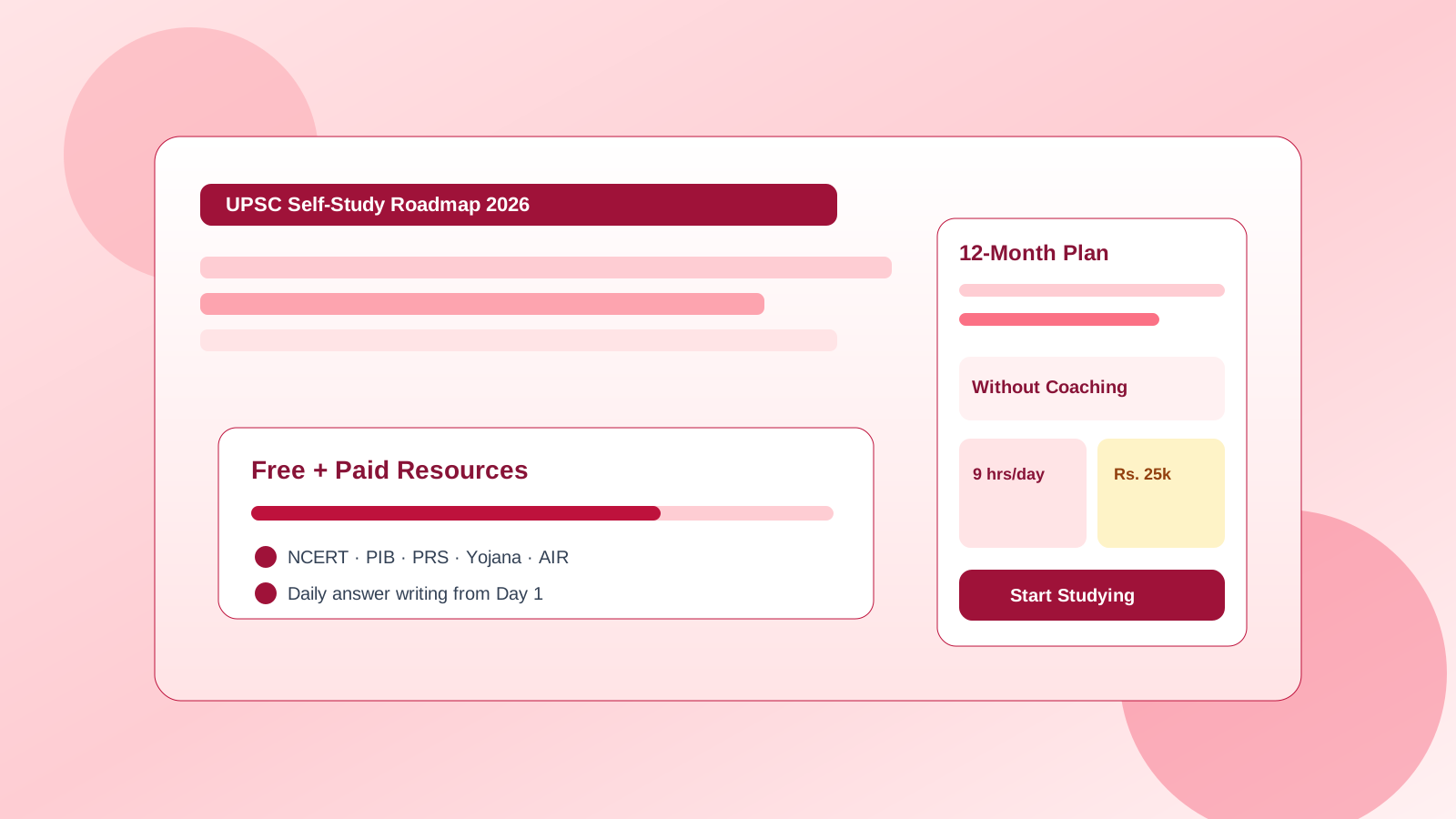
Total study target: 2,500 to 3,000 hours over 12 months — that is roughly 7 to 9 focused hours per day.
Month 1 to 3 - Foundation Phase
Goal: finish all NCERTs and one standard book each for Polity and Modern History.
- NCERT Class 6 to 12: History (Themes I, II, III), Geography (all five books), Polity (Class 9 to 12), Economy (Class 9 to 12), Science (Class 6 to 10), Sociology (Class 11 to 12).
- M. Laxmikanth - Indian Polity (read once, mark important).
- Spectrum - A Brief History of Modern India.
- Start the newspaper habit - The Hindu or Indian Express. 45 to 60 minutes daily, editorials only after the news pages.
Output by end of month 3:
- Two notebooks: one for static notes, one for current affairs by syllabus topic.
- One full re-attempt of Prelims 2024 - target jump from your baseline by
40 to 60marks.
Month 4 to 6 - Core Subjects + Optional Start
- G.C. Leong - Certificate Physical and Human Geography + finish NCERT Geography revision.
- Ramesh Singh - Indian Economy (selective chapters - macro, banking, budget, planning).
- Shankar IAS Environment book.
- Begin Optional Subject Paper I with one standard textbook + one standard reference.
- Continue daily newspaper.
Output by end of month 6:
- All static GS books read at least once.
- Optional Paper I draft notes ready (
60%syllabus covered). - Two full-length Prelims mocks attempted - target stable score of
100+/200in GS.
Month 7 to 9 - Mains Orientation + Answer Writing
- Start daily answer writing - one question per GS paper, every day. 250 words in 7 minutes per question.
- 2nd ARC reports - Ethics in Governance, Social Capital, Citizen Centric Administration for GS-IV.
- Cover Optional Paper II.
- Solve last 10 years' Prelims GS papers - this single exercise is worth 50+ marks in itself.
- Begin a Prelims test series - 1 sectional + 1 full-length per week.
Output by end of month 9:
- One full revision of all GS subjects done.
- Optional syllabus completed end to end.
- Prelims mock score stable at
110 to 130out of 200.
Month 10 to 12 - Prelims Sprint + Mains Foundation
Last 90 days before Prelims (May 2026 if you are following the official calendar):
- Days 90 to 60: Daily 4 to 5 hours on revision + 3 hours on Prelims tests + CSAT practice.
- Days 60 to 30: 2 full-length Prelims mocks weekly. Solve previous-year Prelims again - this time aim
110+. - Days 30 to 0: Only revision. No new books. Sleep 7 hours. Relax the day before the exam.
After Prelims (assuming Mains in August):
- 100 days of pure Mains practice - 2 GS answers + 1 Optional answer + 1 Essay (weekly) + 1 Mains full mock per fortnight.
4. The Free + Paid Resource List for 2026
Free Resources (Government and Official)
- NCERT books - download free PDFs from
ncert.nic.in. - PIB (Press Information Bureau) - daily releases on government decisions.
- PRS India - bill summaries and policy briefs in plain English.
- Yojana and Kurukshetra magazines - free monthly PDFs.
- AIR Spotlight, Rajya Sabha TV - Big Picture archive - 25-minute analysis on key topics.
- India Year Book - one-stop reference for schemes and ministries.
- Economic Survey of India - read both volumes once.
- Union Budget speech and Budget at a Glance.
- Ministry of External Affairs - briefings on bilateral and multilateral meetings.
- Supreme Court India - landmark judgement summaries.
Paid (Optional but High-ROI) Resources
- One Prelims test series (online).
- One Mains test series (online) with evaluated answer scripts.
- Current affairs monthly compilation subscription.
- One book per subject instead of three. The cost is
Rs. 5,000 to 10,000for the entire bookshelf.
Total budget for a 12-month self-study cycle (excluding device/internet): Rs. 15,000 to 25,000, compared to Rs. 1.5 to 2.5 lakh for offline coaching.
5. The Ideal Daily Routine (Working at Home)
A sustainable schedule beats an aggressive one. Sample daily plan:
06:30 to 07:30- Wake up, exercise, light breakfast.07:30 to 09:30- Static subject - hardest first (Polity, Economy, History rotated).09:30 to 10:30- Newspaper + current affairs notes.10:30 to 11:00- Break.11:00 to 13:30- Optional subject.13:30 to 14:30- Lunch + power nap (max 25 minutes).14:30 to 16:30- Second static subject of the day.16:30 to 17:00- Tea break + walk.17:00 to 18:30- Answer writing practice (one GS question per day to begin).18:30 to 19:30- Revision of yesterday's notes (the single most under-used hour).19:30 to 21:00- Dinner + family time + light reading (Yojana, EPW or PIB).21:00 to 22:00- Mock test review or 30 MCQs from previous-year papers.22:30- Sleep. Non-negotiable.
Total study time: 8 to 9 hours of focused work + 1 hour of light review.
For working professionals, compress this into a 4 to 5 hour weekday + 10 to 12 hour weekend cycle and stretch the timeline to 18 months.
6. Answer Writing - The Single Biggest Differentiator
Self-study aspirants who lose Mains usually share one trait: they started writing answers only after Prelims.
- Begin on day one with
1 question per day, 250 words, 7 minutes. By month 6, scale to2 questions per day. By month 9, scale to3 to 4 questions per day. - Use a simple structure - introduction (2 lines), 3 to 4 body points (with examples), conclusion (2 lines).
- Add diagrams, flowcharts and maps wherever possible. They are the easiest way to stand out in a sea of text-only answers.
- After writing, read it once and self-evaluate against a topper's copy on freely available toppers' answer-script PDFs.
- Once a week, get one answer reviewed by a peer in a Telegram or Discord study group.
7. Building a Peer Community Online
Self-study does not mean studying alone. Use these communities to replicate the coaching environment:
- Telegram study groups organised by optional subject and exam year.
- Discord servers for daily answer-writing accountability.
- r/IndianAdministrativeService on Reddit for AMA threads with selected officers.
- Twitter/X - follow 5 to 10 selected officers, beat journalists and the official UPSC handle. Mute everyone else.
Set a strict 45-minute social media cap per day. Endless scrolling is the silent killer of self-study.
8. Top 7 Mistakes Self-Study Aspirants Make
- Reading too many books per subject. Five books read once is worse than one book read five times.
- Starting current affairs in month 11. It must start on day one.
- Skipping CSAT. Engineers fail Prelims here every year. Do
30 minutes dailyfrom month 4. - Ignoring previous-year question papers. Solve last 10 years - of both Prelims and Mains - twice.
- Postponing answer writing till after Prelims. This is the most common reason 12-month plans become 24-month plans.
- Choosing optional based on coaching marketing. Choose by personal interest + scoring trend + study material availability.
- No revision plan. Revise weekly (last 7 days), monthly (last 4 weeks) and quarterly (full subject sweep).
9. Health, Sleep and Mental Discipline
- Sleep 7 hours minimum. Sleep-deprived revision is a waste of revision.
- 30 minutes of cardio or yoga, 5 days a week - this directly improves recall.
- Limit screen time outside study hours. Blue light at night destroys deep sleep.
- Talk to family about your timeline and money plan. UPSC drop years can hurt mental health if expectations are not aligned at home.
- Consider a once-a-month full off day - cinema, family, hike. Sustained 12 months without breaks burns out 70% of aspirants.
10. Bottom Line
UPSC CSE 2026 is fully crackable from home without coaching if you commit to structure, daily answer writing, ruthless revision and honest test feedback. The same exam that produced AIR-1 self-study toppers in 2022, 2023 and 2024 is equally fair to you.
For a free Prelims diagnostic test, daily MCQ practice, monthly current affairs digests and Mains answer-writing modules built specifically for self-study aspirants, explore the UPSC preparation suite on ApnaTestPrep.