
UPSC
UPSC Civil Services Exam 2026: Complete Guide to Dates, Eligibility, Syllabus, Posts and Salary
UPSC Civil Services Exam 2026: The Complete Guide
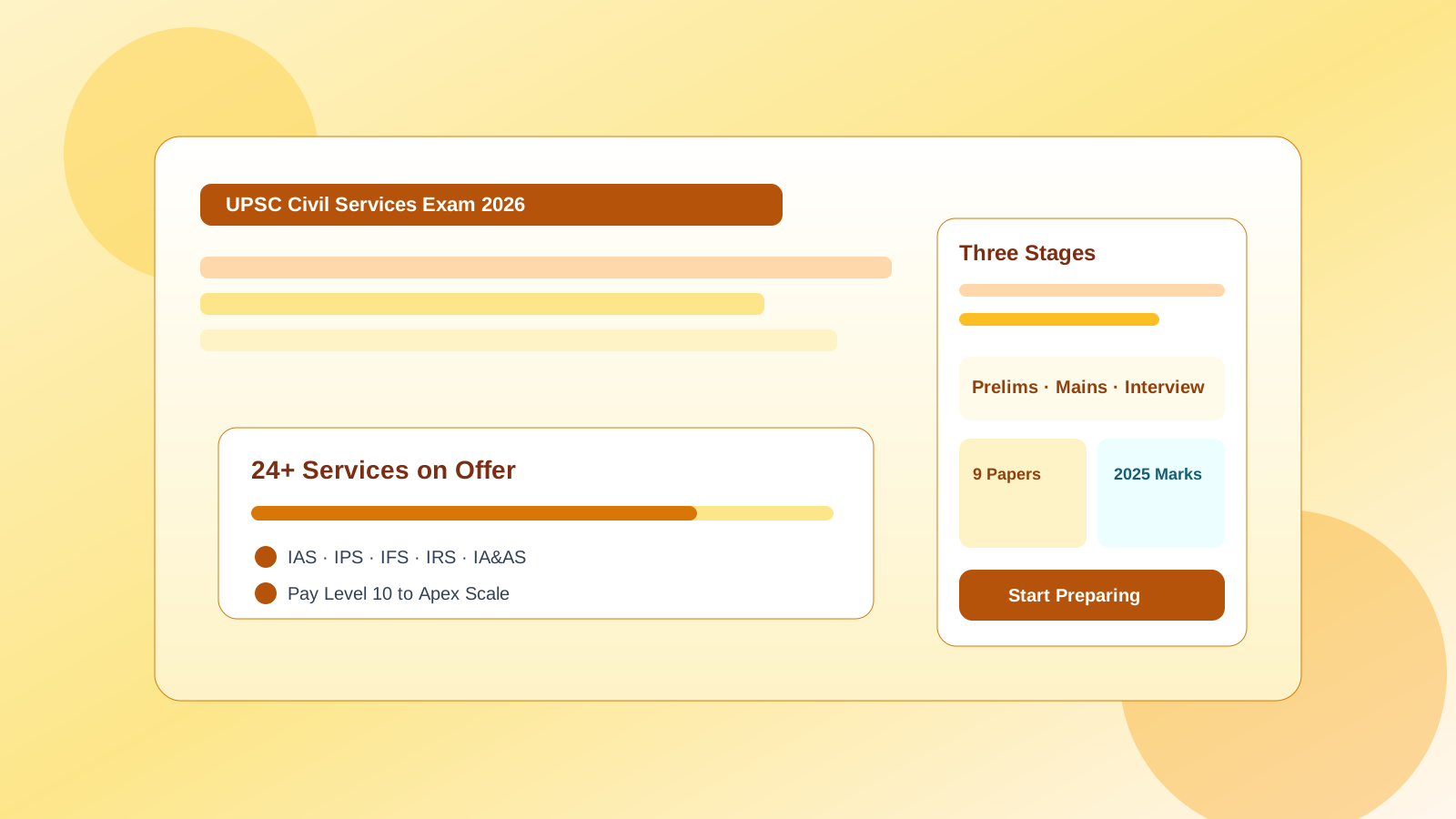
The Union Public Service Commission (UPSC) Civil Services Examination (CSE) is India's most prestigious recruitment test. Every year, around 10 lakh aspirants apply for roughly 1,000 vacancies spread across the All India Services and Central Civil Services Group A and B. This guide pulls together everything you need to know about CSE 2026 — official dates, eligibility, the full three-stage exam pattern, the complete syllabus, all the services and posts you can join, expected salary, and a realistic preparation roadmap.
1. What Is the UPSC Civil Services Exam?
UPSC CSE is the single common exam that recruits officers for around 24 different services including:
- Indian Administrative Service (IAS)
- Indian Police Service (IPS)
- Indian Foreign Service (IFS)
- Indian Revenue Service — Income Tax and Customs and Indirect Taxes
- Indian Audit and Accounts Service (IA&AS)
- Indian Railway Management Service (IRMS — civil services entry)
- Indian P&T Accounts and Finance Service
- Indian Defence Accounts Service
- Indian Information Service
- Indian Postal Service
- Indian Trade Service
- Armed Forces Headquarters Civil Service
- Several Central Group B services (DANICS, DANIPS, Pondicherry Civil and Police, etc.)
The exam is conducted in three sequential stages: Preliminary, Mains, and Personality Test (Interview). Only candidates who clear each stage move to the next.
2. UPSC CSE 2026 — Important Dates
These dates are based on UPSC's Annual Examination Calendar released in May 2025. Always cross-verify with the official notification on upsc.gov.in and upsconline.gov.in.
- Notification release:
14.01.2026 - Online application start:
14.01.2026 - Last date to apply:
03.02.2026 (18:00 Hrs) - Application correction window:
04.02.2026 to 10.02.2026 - Prelims exam date:
24.05.2026 (Sunday) - Prelims result: tentatively
June 2026 - Mains exam date:
21.08.2026 onwards (5 days) - Mains result: tentatively
December 2026 - Personality Test (Interview):
January to April 2027 - Final result:
April or May 2027
The full cycle, from notification to final result, runs for roughly 15 to 16 months.
3. Eligibility Criteria for UPSC CSE 2026
Nationality
- For IAS, IPS and IFS: candidate must be a citizen of India.
- For other services: Indian citizen, or subject of Nepal/Bhutan, or a Tibetan refugee who came to India before 1 January 1962, or a person of Indian origin who migrated from specific countries with the intention of permanently settling in India.
Age Limits (as on 01.08.2026)
- Minimum age:
21 years - Maximum age (General/EWS):
32 years
Upper age relaxation:
- OBC (NCL):
35 years(3 years relaxation) - SC/ST:
37 years(5 years relaxation) - PwBD (Benchmark Disability) General/EWS:
42 years - PwBD OBC:
45 years - PwBD SC/ST:
47 years - Defence Services personnel disabled in operations:
35 years - Ex-servicemen (commissioned officers/ECOs/SSCOs with 5 years military service):
37 years
Number of Attempts
- General/EWS:
6 attempts - OBC (NCL):
9 attempts - SC/ST: unlimited up to upper age limit
- PwBD General/EWS/OBC:
9 attempts - PwBD SC/ST: unlimited up to upper age limit
Appearing in the Prelims counts as one attempt; if you do not appear in any paper of Prelims, it is not counted.
Educational Qualification — Graduation Requirement
You must hold a degree from any recognized university (or a qualification recognized by the Government of India as equivalent). Specifically:
- Bachelor's degree in any stream — Arts, Commerce, Science, Engineering, Medicine, Law, etc.
- Degree from a Statutory/Central/State/Deemed University, Open University, or recognized correspondence/distance programme is accepted.
- Final-year students can also apply for the Prelims, but must produce proof of passing along with the Mains application.
- Candidates with a professional/technical qualification recognized by Government as equivalent to a professional/technical degree are eligible.
- MBBS final-year/internship candidates must submit a certificate of completion of internship at the time of interview.
There is no minimum percentage requirement in graduation for UPSC CSE.
Physical Standards
Candidates recommended for IPS, IFS and certain other services must meet specific physical standards (height, chest, vision) as laid down in the Rules.
4. Stage-Wise Exam Pattern
Stage 1 — Preliminary Examination (objective, screening only)
Two papers, both held on the same day:
- Paper I — General Studies (GS): 100 questions, 200 marks, 2 hours
- Paper II — CSAT (Civil Services Aptitude Test): 80 questions, 200 marks, 2 hours
Key points:
- Negative marking:
1/3rdof the marks for each wrong answer. - CSAT (Paper II) is qualifying only: minimum
33%(i.e., 66 out of 200). - Final Prelims merit is decided only on GS Paper I marks of those who clear CSAT.
- Marks of Prelims are not added to the final ranking.
Stage 2 — Main Examination (descriptive, written)
Nine papers in total, conducted over five days:
- Paper A — Indian Language (qualifying, 300 marks): one of the languages listed in the 8th Schedule.
- Paper B — English (qualifying, 300 marks).
- Essay — 250 marks.
- GS Paper I — Indian Heritage and Culture, History, Geography of the World and Society, 250 marks.
- GS Paper II — Governance, Constitution, Polity, Social Justice and International Relations, 250 marks.
- GS Paper III — Technology, Economic Development, Bio-diversity, Environment, Security and Disaster Management, 250 marks.
- GS Paper IV — Ethics, Integrity and Aptitude, 250 marks.
- Optional Paper I — 250 marks.
- Optional Paper II — 250 marks.
Total counted marks (for ranking): 1750.
Papers A and B are qualifying with minimum 25%. Marks are not added to the merit but failing them disqualifies the candidate. Each merit paper is 3 hours.
Stage 3 — Personality Test / Interview
- Maximum marks:
275 - Conducted by a UPSC Board at Dholpur House, New Delhi.
- Duration: usually
30 to 35 minutes. - Tests mental alertness, critical assimilation, balance of judgement, leadership, intellectual and moral integrity.
Grand total for final ranking: 1750 (Mains) + 275 (Interview) = 2025 marks.
5. Optional Subjects (Choose One)
Candidates pick one optional subject from a list of 48 options that includes:
- Agriculture, Animal Husbandry & Veterinary Science, Anthropology, Botany, Chemistry, Civil Engineering, Commerce & Accountancy, Economics, Electrical Engineering, Geography, Geology, History, Law, Management, Mathematics, Mechanical Engineering, Medical Science, Philosophy, Physics, Political Science & International Relations, Psychology, Public Administration, Sociology, Statistics, Zoology
- Plus literature of any one of: Assamese, Bengali, Bodo, Dogri, Gujarati, Hindi, Kannada, Kashmiri, Konkani, Maithili, Malayalam, Manipuri, Marathi, Nepali, Odia, Punjabi, Sanskrit, Santhali, Sindhi, Tamil, Telugu, Urdu, English
6. Detailed Syllabus Snapshot
Prelims GS Paper I
- Current events of national and international importance
- History of India and Indian National Movement
- Indian and World Geography (Physical, Social, Economic)
- Indian Polity and Governance — Constitution, Political System, Panchayati Raj, Public Policy, Rights Issues
- Economic and Social Development — Sustainable Development, Poverty, Inclusion, Demographics, Social Sector initiatives
- General issues on Environmental Ecology, Bio-diversity and Climate Change
- General Science
Prelims CSAT (Paper II)
- Comprehension
- Interpersonal skills including communication skills
- Logical reasoning and analytical ability
- Decision making and problem solving
- General mental ability
- Basic numeracy (Class X level), Data Interpretation (Class X level)
Mains GS Paper I
- Indian culture: Art forms, literature and architecture from ancient to modern times
- Modern Indian history (mid-18th century to present), the Freedom Struggle, post-independence consolidation
- World History — events from the 18th century like industrial revolution, world wars, redrawal of national boundaries, decolonization, political philosophies (capitalism, socialism, communism)
- Indian society and diversity, role of women, population issues, urbanization, globalization, social empowerment, communalism, regionalism, secularism
- Salient features of world physical geography, distribution of resources, factors for industrial location, geophysical phenomena
Mains GS Paper II
- Indian Constitution — historical underpinnings, evolution, features, amendments, basic structure
- Functions and responsibilities of Union and States, federal structure, devolution
- Separation of powers, dispute redressal mechanisms
- Comparison of Indian constitutional scheme with other countries
- Parliament and State Legislatures — structure, functioning, business, powers, privileges
- Executive and Judiciary structure, Ministries and Departments
- Salient features of RPA
- Statutory, regulatory and quasi-judicial bodies
- Government policies and interventions, welfare schemes
- Issues relating to development and management of Social Sector/Services (Health, Education, Human Resources)
- Governance, transparency, accountability, e-governance, citizen charters
- Role of civil services in democracy
- India and its neighbourhood, bilateral, regional and global groupings, effect of policies of developed and developing countries on India's interests, Indian diaspora, important international institutions
Mains GS Paper III
- Indian Economy — planning, mobilization of resources, growth, development, employment
- Inclusive growth and issues
- Government Budgeting
- Major crops, cropping patterns, irrigation, storage, transport, marketing, e-technology in agriculture
- Public Distribution System, food security, buffer stocks, animal rearing
- Food processing, land reforms
- Effects of liberalization on the economy, industrial policy
- Infrastructure — energy, ports, roads, airports, railways
- Investment models
- Science and Technology — developments, indigenization, achievements of Indians
- IT, Space, Computers, Robotics, Nano-tech, Bio-tech, IPR
- Environment conservation, EIA, disaster management
- Linkages between development and spread of extremism
- Role of external state and non-state actors in creating challenges to internal security
- Cyber security, money laundering, organized crime, terrorism, border management
Mains GS Paper IV — Ethics, Integrity and Aptitude
- Ethics and human interface, dimensions of ethics, ethics in private and public relationships
- Human values — lessons from leaders, reformers, administrators
- Attitude — content, structure, function, moral and political attitudes
- Aptitude and foundational values for civil service — integrity, impartiality, objectivity, dedication, empathy, tolerance, compassion
- Emotional intelligence — concepts and applications in administration
- Public/civil service values and ethics in public administration
- Probity in governance, codes of ethics and conduct, work culture, RTI, corporate governance
- Case studies on the above issues
7. The Services and Posts on Offer
All India Services (cadre allocated to a State)
- IAS — Indian Administrative Service: District Magistrate/Collector, Sub-Divisional Magistrate, Joint Secretary/Secretary in Centre and States, Cabinet Secretary at the apex. Responsible for general administration, revenue collection, law and order coordination, policy implementation, and disaster management.
- IPS — Indian Police Service: ASP/SP, SSP, DIG, IG, DGP, Director CBI/IB, Director NIA. Responsible for internal security, law and order, crime prevention and detection, traffic, and counter-terrorism.
- IFS — Indian Foreign Service: Third Secretary onwards, Ambassador/High Commissioner, Foreign Secretary. Represents India abroad, manages diplomatic missions, consular work, treaty negotiations, MEA functions.
Central Civil Services Group A
- IRS (IT) — Income Tax: Assistant Commissioner to Principal Chief Commissioner. Direct tax assessment, investigation, prosecution, search and seizure operations.
- IRS (C&IT) — Customs and Indirect Taxes: GST and Customs administration, anti-smuggling, narcotics control (DRI, NCB postings).
- IA&AS — Indian Audit and Accounts Service: Audit of Union, State, PSUs and autonomous bodies under the CAG; expenditure and performance audit.
- ICAS — Indian Civil Accounts Service: Payment, accounting and internal audit of all Civil Ministries of the Union.
- IDAS — Indian Defence Accounts Service: Accounts, audit and financial advice for the Armed Forces, DRDO, Border Roads, Coast Guard.
- IPoS — Indian Postal Service: Heads Postal Circles, manages mail, savings bank, insurance and parcel operations.
- IRPFS — Railway Protection Force Service: Security of railway property, passengers and operations.
- IRMS — Indian Railway Management Service (civil services stream): General management of Indian Railways across operations, finance, personnel, traffic and stores.
- IIS — Indian Information Service: PIB, AIR, Doordarshan, Press Information, public communications.
- ITS — Indian Trade Service: DGFT — foreign trade policy formulation and implementation.
- AFHCS — Armed Forces Headquarters Civil Service: Civilian staff officers in Service HQs.
- IP&TAFS — Indian P&T Accounts and Finance Service: Accounts and finance for telecom and post departments.
- ICLS — Indian Corporate Law Service: MCA, ROC, RD, NCLT — corporate compliance and Companies Act enforcement.
Central Civil Services Group B
- DANICS — Civil Service for Delhi, Andaman & Nicobar, Lakshadweep, Daman & Diu, Dadra & Nagar Haveli (Sub-Divisional Magistrate level entry).
- DANIPS — Police Service for the same UTs (ASP/DCP level entry).
- Pondicherry Civil Service.
- Pondicherry Police Service.
8. Salary, Allowances and Career Progression
UPSC services follow the 7th Central Pay Commission structure. Indicative pay levels for direct recruits at entry:
- Entry pay (Junior Time Scale) — Level 10: basic
₹56,100. With DA, HRA, TA, in-hand often₹80,000 – ₹1,00,000per month. - After 4 years — Senior Time Scale (Level 11): basic
₹67,700. - After 9 years — Junior Administrative Grade (Level 12): basic
₹78,800. - After 13 years — Selection Grade (Level 13): basic
₹1,23,100. - After 16 years — Super Time Scale (Level 14): basic
₹1,44,200. - After 25 years — Above Super Time Scale (Level 15): basic
₹1,82,200. - Apex Scale (Level 17) — Cabinet Secretary, Chief Secretary:
₹2,25,000(fixed).
Officers are entitled to government accommodation, official vehicle (at suitable levels), domestic help allowance, leave travel concession, study leave (for higher education abroad/in India), medical benefits under CGHS, and pension/NPS.
9. Cut-Off Trends (CSE 2024 — Indicative)
- Prelims GS-1 cut-off (out of 200): General
~87, EWS~85, OBC~87, SC~79, ST~74, PwBD-1~52. - Mains written cut-off (out of 1750): General
~741, EWS~706, OBC~712, SC~694, ST~692. - Final cut-off (out of 2025): General
~937, EWS~899, OBC~916, SC~890, ST~884.
These vary every year by 10 to 30 marks based on paper difficulty and vacancies.
10. Smart Preparation Strategy
Phase 1 — Foundation (3 to 4 months)
- Read NCERTs from class 6 to 12 for History, Geography, Polity, Economy, Science and Environment.
- Build daily newspaper habit — The Hindu or Indian Express. Make crisp running notes by topic, not by date.
- Pick your optional subject early; the wrong choice can cost a year.
Phase 2 — Standard Books (4 to 5 months)
- Polity — M. Laxmikanth
- Modern History — Bipan Chandra / Spectrum
- Economy — Ramesh Singh / Sanjeev Verma
- Geography — G.C. Leong + NCERTs
- Environment — Shankar IAS Environment book
- Ethics — Lexicon or Subba Rao with case studies
- CSAT — TMH CSAT manual + previous year CSAT papers
Phase 3 — Answer Writing and Revision (Continuous)
- Write at least one full GS answer daily; one full Mains essay weekly.
- Solve last 10 years' Prelims and Mains question papers before any test series.
- Join a Mains test series 6 months before Mains; a Prelims test series 4 months before Prelims.
- Revise each subject at least 3 times before Prelims and 2 more times before Mains.
Phase 4 — Interview (2 to 3 months after Mains)
- Build a DAF (Detailed Application Form) based knowledge bank — your home state, hobbies, optional, work experience, current affairs.
- Practice 4 to 6 mock interviews with senior aspirants and reputed boards.
- Stay calm, be honest, and practice the art of disagreeing politely.
11. Realistic Timelines and Common Mistakes
A serious aspirant typically needs 12 to 18 months of focused preparation to make a strong first attempt. Common mistakes that delay success:
- Hoarding 30+ books per subject instead of revising 5 books five times.
- Neglecting CSAT — engineers especially can lose the year here if they don't practice.
- Ignoring answer-writing till after Prelims.
- Choosing an optional based on coaching marketing rather than personal interest and scoring trends.
- Not making own concise notes from current affairs.
12. Bottom Line
UPSC CSE 2026 is a long but rewarding journey. The exam rewards clarity over cleverness, consistency over cramming, and ethics over shortcuts. With a strong NCERT foundation, the right optional, daily answer practice, and disciplined revision, even a first-time aspirant can convert in 12 to 18 months.
For official updates, always refer to upsc.gov.in and upsconline.gov.in. For free Prelims and Mains practice on the latest pattern, explore the UPSC mock tests and study material on ApnaTestPrep.