
SSC CGL
SSC CGL 2026: Complete Guide to Dates, Eligibility, Syllabus, Posts and Salary
SSC CGL 2026: The Complete Guide
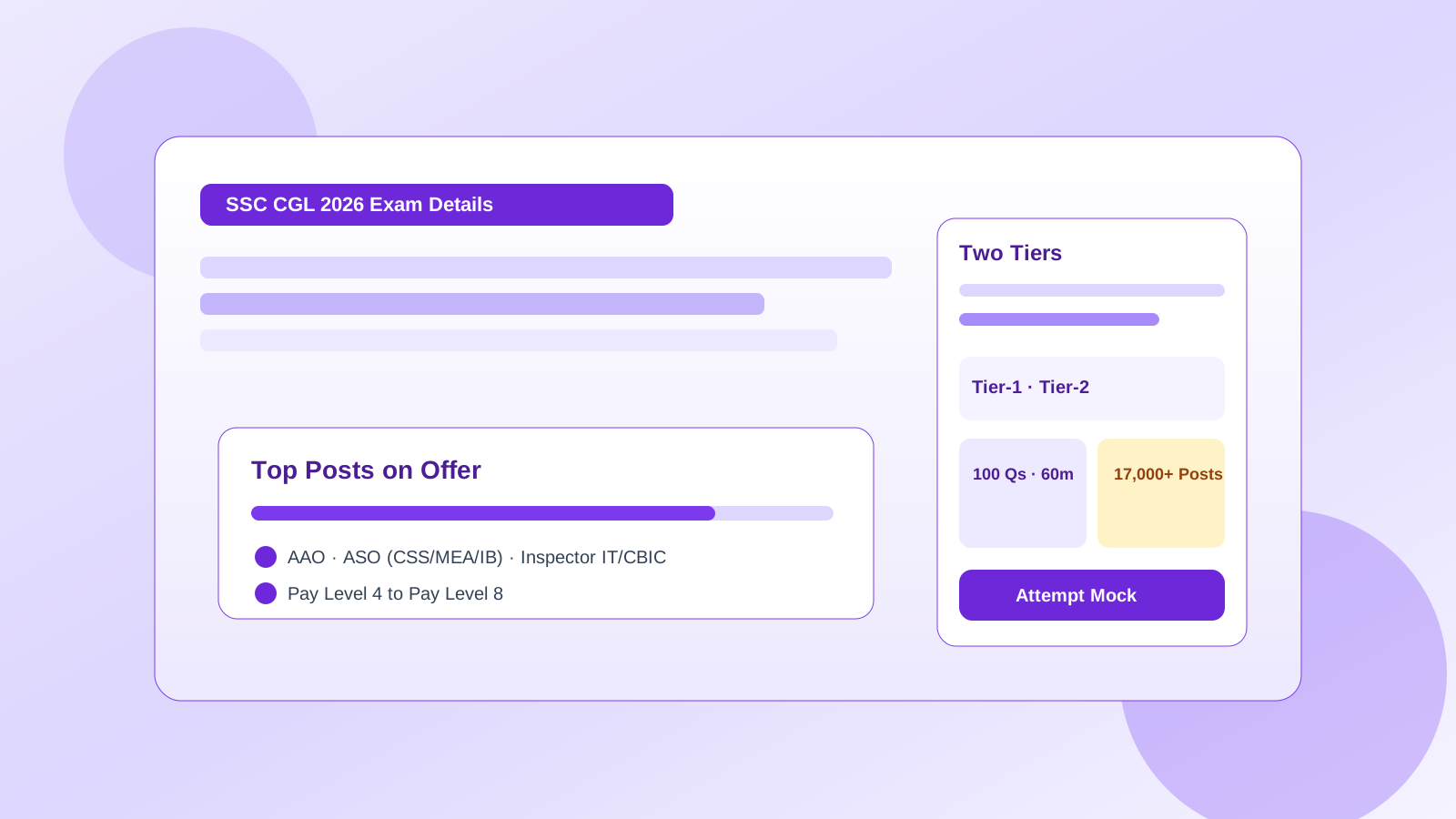
The Staff Selection Commission Combined Graduate Level (SSC CGL) is the largest recruitment exam for Group B and Group C posts in Central Government Ministries, Departments and Subordinate Offices. Each year roughly 30 to 40 lakh candidates apply for around 17,000 to 20,000 vacancies across Inspector Income Tax, Inspector CBIC (GST and Customs), Assistant Section Officer in CSS/MEA/IB, Auditor, Junior Statistical Officer and dozens of other coveted desks. This guide covers everything you need for SSC CGL 2026 — official dates, eligibility and graduation requirements, the full two-tier pattern, syllabus, every post on offer with detailed roles, salary, and a realistic preparation roadmap.
1. What Is SSC CGL?
SSC CGL is a single combined exam conducted by the Staff Selection Commission every year to fill vacancies in:
- Group "B" Gazetted (non-ministerial) posts — Assistant Audit Officer, Assistant Accounts Officer
- Group "B" non-Gazetted posts — Assistant Section Officer (CSS, IB, MEA, Railways, AFHQ), Inspector (Income Tax / CBIC / Examiner / Preventive Officer), Sub-Inspector (CBI, NIA), Junior Statistical Officer, Assistant Enforcement Officer
- Group "C" posts — Auditor, Accountant, Senior Secretariat Assistant, Tax Assistant, Upper Division Clerk
Selection happens through a sequential Tier-1 (objective screening) and Tier-2 (objective + descriptive + skill) pattern, followed by document verification and (where applicable) Skill Test or Computer Proficiency Test.
2. SSC CGL 2026 — Important Dates
These dates are based on the SSC Annual Examination Calendar released for 2026 and are tentative; always verify on ssc.gov.in.
- Notification release: tentatively
09.06.2026 - Online application start:
09.06.2026 - Last date to apply:
04.07.2026 (23:00 Hrs) - Application correction window:
09.07.2026 to 11.07.2026 - Tier-1 exam date: tentatively
September 2026 - Tier-1 result: tentatively
November 2026 - Tier-2 exam date: tentatively
December 2026 - Tier-2 result: tentatively
February 2027 - Document Verification and Final Allocation:
April–May 2027
3. Eligibility Criteria for SSC CGL 2026
Nationality
Candidate must be one of:
- A citizen of India, or
- A subject of Nepal, or
- A subject of Bhutan, or
- A Tibetan refugee who came to India before 1 January 1962 with the intention of permanent settlement, or
- A person of Indian origin who migrated from specified countries with the intention of permanent settlement.
Candidates from non-Indian categories must hold an eligibility certificate issued by the Government of India.
Age Limits (as on 01.08.2026)
Age limits vary by post. Indicative bands:
- General band:
18 – 27 years(most posts like Auditor, UDC, Tax Assistant, Accountant) 20 – 30 years: Assistant Section Officer (CSS, MEA, IB, AFHQ), Inspector of Posts, Assistant Audit Officer/Accounts Officer, Assistant Enforcement Officer18 – 30 years: Inspector (CBIC, Income Tax, Examiner, Preventive Officer), Sub-Inspector (CBI), Junior Statistical Officer20 – 30 years: Sub-Inspector (NIA), Assistant in Other Ministries18 – 32 years: Statistical Investigator Grade-II (in some years)
Upper age relaxation:
- OBC (NCL):
+3 years - SC/ST:
+5 years - PwBD (UR):
+10 years; OBC PwBD+13 years; SC/ST PwBD+15 years - Ex-Servicemen:
+3 yearsafter deduction of military service rendered - Central Government civilian employees with
3 yearscontinuous service:+5 years(UR) - Defence personnel disabled in operations:
+3 years(UR),+8 years(SC/ST) - Widows/divorced women not remarried: up to
35 years(UR),40 years(SC/ST)
Educational Qualification — Graduation Requirement
The minimum educational qualification is a Bachelor's degree from a recognized university, but specific posts add extra requirements:
- Most posts (Auditor, Accountant, ASO, Tax Assistant, UDC, Inspector etc.): Bachelor's degree in any discipline.
- Junior Statistical Officer (JSO): Bachelor's degree in any discipline with at least 60% marks in Mathematics at 12th standard, OR Bachelor's degree with Statistics as one of the subjects.
- Statistical Investigator Grade-II: Bachelor's degree with Statistics as one of the subjects (in years it is notified).
- Assistant Audit Officer / Assistant Accounts Officer: Bachelor's degree in any subject. Desirable: CA / CS / MBA / M.Com / M.Stats / M.Eco.
- Compiler (Registrar General of India): Bachelor's degree with Economics or Statistics or Mathematics as a compulsory or elective subject.
There is no minimum percentage prescribed for graduation in most posts. Final-year students can apply provided they hold the degree as on the cut-off date (usually 1 August of the exam year) — be careful, this is often a source of disqualification.
Number of Attempts
- No restriction on the number of attempts — candidates can appear as many times as they want until they cross the upper age limit applicable to the post.
Physical Standards (only for some posts)
Required for Inspector (CBIC) — Examiner / Preventive Officer, Sub-Inspector (CBI) and Sub-Inspector (NIA):
- Male: height
170 cm, chest80 cm(expansion 5 cm). Hill-area / SC/ST candidates: relaxed standards. - Female: height
150 cm, weight48 kg. - Vision: distant
6/6and6/9(better and worse eye, without glasses).
Skill / Typing Test
- Tax Assistant (CBDT/CBIC): Data Entry Speed Test —
8,000 key depressions per houron a computer. - Assistant Section Officer (CSS), Senior Secretariat Assistant: Computer Proficiency Test (CPT) consisting of Word Processing, Spreadsheet and Generation of Slides.
4. Stage-Wise Exam Pattern (SSC CGL 2026)
SSC CGL 2026 follows the revised two-tier structure introduced in CGL 2022.
Tier-1 — Computer Based Examination (Screening)
- Duration:
60 minutes(80 minutesfor PwBD with scribe) - Mode: Online (CBT)
- Total questions: 100
- Total marks: 200
- Negative marking:
0.50for each wrong answer
| Section | Questions | Marks |
|---|---|---|
| General Intelligence and Reasoning | 25 | 50 |
| General Awareness | 25 | 50 |
| Quantitative Aptitude | 25 | 50 |
| English Comprehension | 25 | 50 |
Tier-1 is qualifying for Tier-2 based on category-wise cut-offs.
Tier-2 — Computer Based Examination (Final Selection)
Tier-2 is conducted in 3 sessions over multiple days:
#### Session 1 (same day)
- Paper I — common for all posts — 3 sections, conducted in two sittings:
- Section I — Mathematical Abilities (
30 questions,90 marks) + Reasoning and General Intelligence (30 questions,90 marks). Time:1 hour. - Section II — English Language and Comprehension (
45 questions,135 marks) + General Awareness (25 questions,75 marks). Time:1 hour. - Section III — Computer Knowledge Module (
20 questions,60 marks) — qualifying. Time:15 minutes. - Negative marking:
1mark for wrong answer in Section I and Section II;0.50in Section III.
#### Session 2 (same day)
- Data Entry Speed Test (DEST) Module — qualifying — only for Tax Assistant:
2000 key depressions in 15 minutes.
#### On a separate day
- Paper II — Statistics (200 marks, 2 hours) — only for Junior Statistical Officer post applicants.
- Paper III — General Studies (Finance & Economics) (200 marks, 2 hours) — only for Assistant Audit Officer / Assistant Accounts Officer post applicants.
Negative marking in Paper II and Paper III: 0.50 per wrong answer.
Final Selection
- Final merit is prepared based on Tier-2 marks (Paper I, plus Paper II / Paper III where applicable).
- Tier-1 is only for screening into Tier-2 and not added to final merit (since CGL 2022 onwards).
- After merit, candidates are called for Document Verification, and (where required) DEST / CPT / Physical Standards.
5. Detailed Syllabus Snapshot
Tier-1
General Intelligence and Reasoning (verbal + non-verbal):
- Analogies, similarities and differences, space visualization, spatial orientation
- Problem solving, analysis, judgement, decision-making
- Visual memory, discriminating observation, relationship concepts
- Arithmetical reasoning, figural classification, arithmetic number series, non-verbal series
- Coding-decoding, statement-conclusion, syllogistic reasoning
- Semantic analogy, classification, series, figural pattern, Venn diagrams, drawing inferences
General Awareness:
- Current affairs (national and international, last 6 to 12 months)
- History (Ancient, Medieval, Modern, Indian National Movement)
- Geography (Indian and World)
- Polity (Constitution, Parliament, Judiciary, Panchayati Raj)
- Economy (basic concepts, budget, RBI, banking, schemes)
- Science (Physics, Chemistry, Biology — basics)
- Static GK (books, awards, sports, important days, capitals, currencies)
Quantitative Aptitude:
- Number system, computation of whole numbers, decimals, fractions
- Percentages, ratio and proportion, square roots, averages, interest (SI/CI)
- Profit and loss, discount, partnership, mixture and alligation
- Time and distance, time and work, pipes and cisterns
- Algebra — basic identities, linear equations, graphs
- Geometry — triangle, circle, regular polygons; coordinate geometry
- Mensuration — 2D and 3D figures
- Trigonometry — ratios, identities, heights and distances
- Statistics — histogram, frequency polygon, bar diagram, pie chart
English Comprehension:
- Spot the error, fill in the blanks, synonyms/antonyms
- Spelling, idioms and phrases, one-word substitution
- Improvement of sentences, active/passive voice, direct/indirect speech
- Cloze passage, comprehension passage
- Sentence rearrangement / parajumbles
Tier-2 Paper I
Largely an expanded version of Tier-1 with deeper Mathematical Abilities (including DI), advanced Reasoning, longer English passages with sentence formation and paragraph based questions, and an additional Computer Knowledge Module covering MS Office, internet, networking basics, software/hardware, cyber security and data representation.
Tier-2 Paper II — Statistics (for JSO)
- Collection, classification and presentation of statistical data
- Measures of central tendency
- Measures of dispersion
- Moments, skewness, kurtosis
- Correlation and regression
- Probability theory
- Random variables and probability distributions
- Sampling theory
- Statistical inference
- Analysis of variance
- Time series analysis
- Index numbers
Tier-2 Paper III — General Studies (Finance and Economics) (for AAO/AAccO)
Part A — Finance and Accounts (80 marks):
- Fundamental principles and basic concepts of accounting
- Financial accounting — nature, scope, basic concepts
- Single and double entry, books of original entry, bank reconciliation
- Journal, ledger, trial balance, rectification of errors
- Manufacturing, trading, profit and loss accounts, balance sheet
- Distinction between capital and revenue expenditure
- Depreciation, inventory valuation, receipts and payments, income and expenditure account
Part B — Economics and Governance (120 marks):
- Comptroller and Auditor General of India — duties, powers
- Finance Commission — role, functions
- Basic concepts of economics — demand and supply, production, market forms
- Indian Economy — nature, role of agriculture, industry, services
- Economic reforms in India since 1991
- Money and Banking — RBI, monetary policy
- Public Finance — Government Budget, FRBM Act, fiscal policy
- Role of IT in Governance — e-governance, GST, Aadhaar
6. Posts Offered Through SSC CGL — Detailed Roles
Group B Gazetted
- Assistant Audit Officer (AAO) — Indian Audit and Accounts Department, CAG: Conducts audits of central, state and PSU accounts. Highest Pay Level among CGL posts (Level 8). Excellent promotional avenue up to Senior Audit Officer.
- Assistant Accounts Officer (AAccO) — Indian Audit and Accounts Department, CAG: Manages accounts of various government departments under the CAG.
Group B (non-Gazetted) — High-Demand Posts
- Assistant Section Officer (ASO), Central Secretariat Service (CSS): Posted in Ministries at Delhi (Lutyens). Drafts notes on policy files, deals with parliament questions, RTI, internal coordination. Promotional ladder: Section Officer → Under Secretary → Deputy Secretary → Director.
- ASO, Ministry of External Affairs (MEA): Posted in MEA HQ and Indian missions abroad for 3-year tenures. Foreign postings include rent-free housing and dollar/euro foreign allowance.
- ASO, Intelligence Bureau (IB): Intelligence gathering, internal security analysis. Reports under MHA.
- ASO, AFHQ (Armed Forces HQ): Civilian secretariat service in Army, Navy, Air Force HQs.
- ASO, Railway Board.
- Inspector of Income Tax (CBDT): Field officer in I-T Department. Investigates returns, conducts surveys/searches/seizures, scrutiny assessments. Promotional ladder: Income Tax Officer (Group B Gazetted) within
5 to 8 years, then Assistant Commissioner of Income Tax (IRS Group A) by promotion in10 to 16 years. - Inspector (Central Excise / GST), CBIC: Field officer for GST and Excise. Scrutiny, audit, anti-evasion, raids on tax-evading units.
- Inspector (Examiner), CBIC — Customs: Examines imported and exported cargo at ports. Posted at major ports (JNPT, Chennai, Cochin, etc.).
- Inspector (Preventive Officer), CBIC — Customs: Anti-smuggling, baggage checking at airports/ICDs.
- Inspector of Posts (Department of Posts): Supervises post offices in a sub-division.
- Sub-Inspector, Central Bureau of Investigation (CBI): Investigation of central government corruption cases, economic offences, special cases referred to CBI. Police powers.
- Sub-Inspector, National Investigation Agency (NIA): Investigates terrorism and threat-to-national-security cases.
- Assistant Enforcement Officer (AEO), Directorate of Enforcement: PMLA and FEMA investigations, money laundering and foreign exchange violations.
- Junior Statistical Officer (JSO), MoSPI: Field statistical operations, NSS surveys, data analysis.
Group C Posts
- Auditor (CAG / CGDA / Other Audit Offices): Office-based audit of expenditure and accounts.
- Accountant / Junior Accountant: Accounting and bills work in various ministries.
- Tax Assistant (CBDT): Data entry, basic verification, support work to ITOs and Inspectors. Eligible for promotion as Senior Tax Assistant and ITI in time.
- Tax Assistant (CBIC): Office support for GST/Customs Inspectors.
- Senior Secretariat Assistant / Upper Division Clerk (UDC): Clerical work in central ministries.
- Compiler (Registrar General of India): Population census-related compilation work.
7. Salary, Allowances and Career Progression
SSC CGL posts span Pay Levels 4 to 8 of the 7th CPC matrix:
- Pay Level 8 (₹47,600 – ₹1,51,100): AAO, AAccO. In-hand Delhi: roughly
₹65,000 – ₹70,000. - Pay Level 7 (₹44,900 – ₹1,42,400): ASO (CSS/MEA/IB/AFHQ/Railway), Inspector Income Tax, Inspector CBIC (Examiner/PO/Excise), AEO, SI CBI, JSO, Inspector of Posts. In-hand Delhi: roughly
₹62,000 – ₹65,000. Inspector posts also get uniform allowance and field/special duty allowance that pushes total in-hand higher. - Pay Level 6 (₹35,400 – ₹1,12,400): Auditor, Accountant, JSO (in some allocations), SI NIA. In-hand Delhi: roughly
₹50,000 – ₹54,000. - Pay Level 5 (₹29,200 – ₹92,300): Senior Secretariat Assistant / UDC, Tax Assistant, Compiler. In-hand Delhi: roughly
₹40,000 – ₹44,000. - Pay Level 4 (₹25,500 – ₹81,100): Some Group C posts notified in particular years.
Allowances:
- DA — revised every 6 months (currently around 50%+ of basic).
- HRA — 27% (X cities like Delhi, Mumbai), 18% (Y cities), 9% (Z cities).
- Transport Allowance with DA component.
- Department-specific allowances — uniform allowance (Inspectors), special duty allowance (NE postings), foreign allowance (MEA postings abroad).
- LTC, CGHS medical, NPS, gratuity.
Career progression (typical, varies by department):
- Inspector Income Tax → Income Tax Officer (Group B Gazetted) in
5 to 8 years→ Assistant Commissioner (IRS, Group A) by promotion in12 to 18 years. - ASO (CSS) → Section Officer in
4 to 8 years→ Under Secretary in12 to 16 years→ Deputy Secretary in18 to 22 years→ Director in22 to 28 years. - Auditor → Senior Auditor → AAO → Audit Officer → Senior AO.
8. Cut-Off Trends (Indicative, SSC CGL 2023 Cycle)
- Tier-1 cut-off (out of 200): UR
~143–146, OBC~134–137, EWS~132–135, SC~119–122, ST~110–115. - Final cut-off (Tier-2 out of 723 for AAO; out of 488 for non-AAO posts): varies sharply by post.
- AAO/AAccO: roughly
400+(out of 723). - ASO (CSS): roughly
345+(out of 488). - Inspector Income Tax / CBIC: roughly
340+(out of 488). - Auditor/Accountant: roughly
295+(out of 488).
Cut-offs change every cycle by 10 to 25 marks depending on paper difficulty and vacancies.
9. Smart Preparation Strategy
Phase 1 — Build Math and English Foundation (2 to 3 months)
- Quant: R.S. Aggarwal (Quantitative Aptitude) for basics, then Rakesh Yadav 7300 and Kiran SSC Mathematics Chapter-wise for SSC-pattern problems. Master percentage, profit/loss, ratio, time-speed, geometry and trigonometry — these form 70% of the paper.
- English: Plinth to Paramount (Neetu Singh) for grammar, Word Power Made Easy (Norman Lewis) for vocabulary. Read a quality newspaper editorial daily.
- Reasoning: R.S. Aggarwal Reasoning for verbal and non-verbal patterns.
Phase 2 — General Awareness (Continuous)
- Lucent General Knowledge for static GK.
- Daily current affairs from a free monthly compilation (last 8 to 10 months at exam time).
- NCERT class 6 to 10 Polity, History, Geography, Economy summaries.
- Track key government schemes, budget highlights, awards, sports events, important days, science and tech updates.
Phase 3 — Previous Years' Papers (4 to 6 months before Tier-1)
- Solve last 10 years' SSC CGL Tier-1 and Tier-2 sectionally first, then full-length.
- Speed matters: target Tier-1 attempt of
90+/100with90%+accuracy. SSC has cut-off above 140 because the questions are short and time-bound.
Phase 4 — Mock Tests and Time Management (Last 2 to 3 months)
- Take at least
3 to 4 sectional mocksweekly and2 full-length CGL mocksweekly. - Review every mock; maintain an error log by topic.
- Build a Tier-1 strategy: most toppers attempt Reasoning → Quant → English → GA to maximise accuracy in early sections when fresh.
Phase 5 — Tier-2 Specific (After Tier-1)
- For Paper I: scale up DI (Data Interpretation), advanced algebra/geometry/trigonometry, and 200-word reading comprehension passages.
- For Computer Knowledge Module: revise MS Office shortcuts, basic networking, internet protocols, cyber security terms.
- For Paper III (AAO/AAccO): read NCERT Economics class 11 and 12, Ramesh Singh Indian Economy, T.S. Grewal Class 11 Accountancy. Cover CAG Act, FRBM Act, Finance Commission and recent Budget thoroughly.
- For Paper II (JSO): stick to S.C. Gupta — Fundamentals of Mathematical Statistics; this paper requires consistent practice.
10. Common Mistakes to Avoid
- Underestimating English Comprehension — engineers and Hindi-medium aspirants often lose 30+ marks here.
- Treating General Awareness as a "scoring" section — without a daily plan it actually drags scores down.
- Solving 50 books once instead of solving
5 books five times. - Ignoring negative marking strategy — wild guessing pulls the score below cut-off.
- Skipping Tier-2 Paper III preparation while applying for AAO post — final merit is decided here.
11. Bottom Line
SSC CGL 2026 remains the single most attractive Group B / C entry point for graduates in India, with no attempt limit, a predictable two-tier pattern, transparent merit-based selection, and a long career runway with promotions to Group A. With strong fundamentals in Math and English, daily current affairs, disciplined mock practice, and a clear post preference (AAO / Inspector / ASO etc.), even a first-time aspirant can convert in 8 to 12 months of focused effort.
For official notifications, always refer to ssc.gov.in. For SSC CGL Tier-1 and Tier-2 mock tests, sectional practice, previous-year papers and current affairs digests, explore the SSC CGL preparation suite on ApnaTestPrep.