
MPPSC
MPPSC State Service Exam 2026: Dates, Eligibility, Syllabus, Posts and Salary - Complete Guide
MPPSC State Service Exam 2026: The Complete Guide
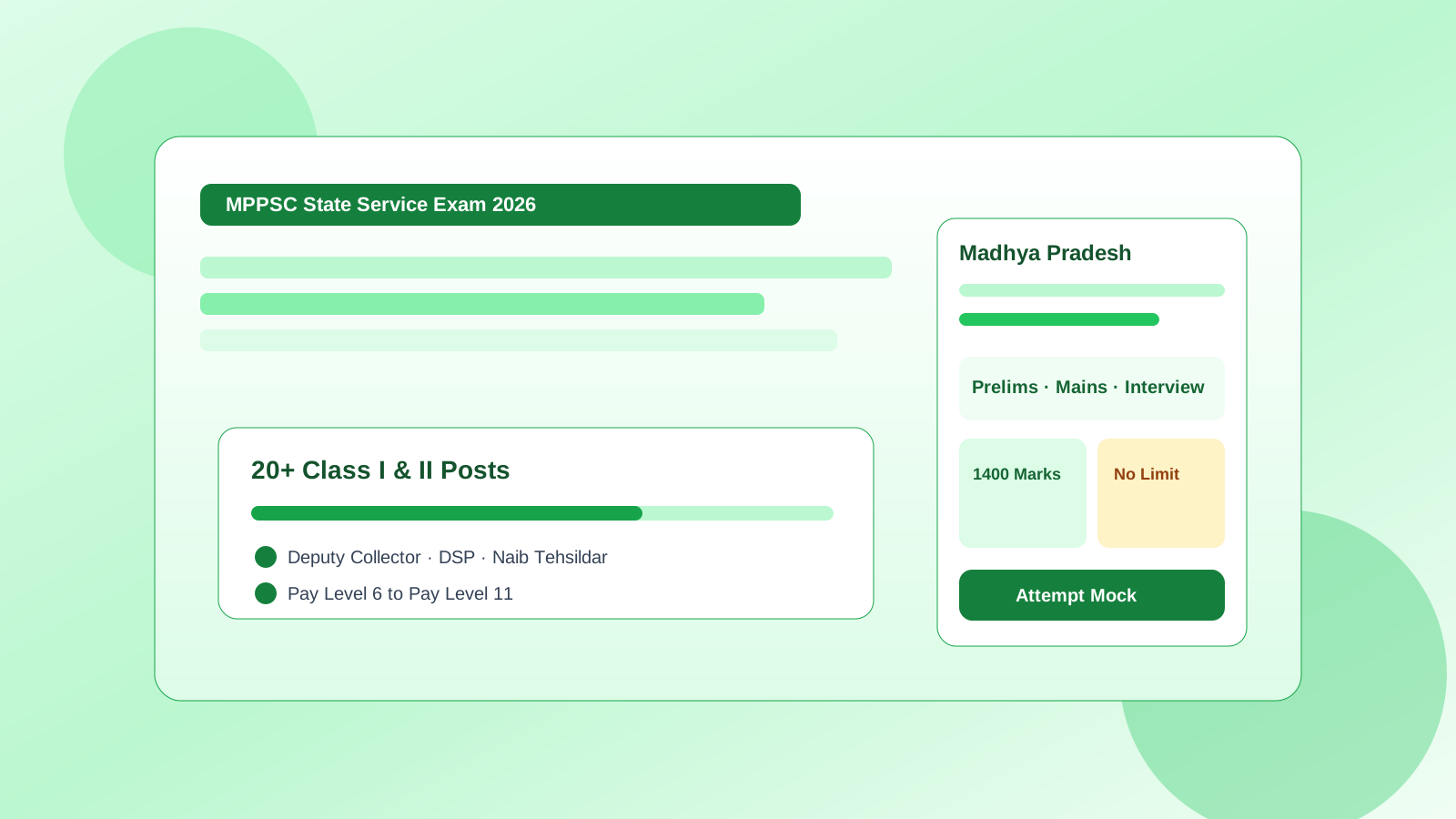
The Madhya Pradesh Public Service Commission (MPPSC) is the constitutional body that recruits Class I and Class II officers for the Government of Madhya Pradesh under Article 315 of the Constitution. Its flagship recruitment is the State Service Examination (SSE), which fills posts like Deputy Collector, Deputy Superintendent of Police (DSP), Naib Tehsildar, District Registrar, Cooperative Inspector and many more. This guide covers everything you need for MPPSC SSE 2026 — official dates, eligibility and domicile rules, the full three-stage exam pattern, syllabus, every post offered, expected salary, and a realistic preparation roadmap.
1. What Is MPPSC SSE?
MPPSC SSE — also called MPPSC State Service Exam or MP Rajya Seva — is a single combined exam that recruits officers across roughly 20+ posts in:
- Madhya Pradesh State Civil Services (similar to IAS at state level)
- Madhya Pradesh State Police Services (similar to IPS at state level)
- Madhya Pradesh Finance, Account, Cooperative and Excise Services
- Madhya Pradesh Naib Tehsildar (Revenue) cadre
- Various other Class I and Class II posts notified by the State Government
It is conducted in three stages: Preliminary, Mains, and Interview, in much the same flow as UPSC CSE but with MP-specific content (Madhya Pradesh history, geography, polity, economy and current affairs).
2. MPPSC SSE 2026 — Important Dates
These dates are based on the MPPSC annual notification cycle and are tentative; always verify on mppsc.mp.gov.in.
- Notification release: tentatively
January–February 2026 - Online application start: along with notification
- Last date to apply: roughly
21 days from notification - Application correction window: usually
3 to 7 daysafter the closing date - Prelims exam date: tentatively
June 2026 (Sunday) - Prelims result: tentatively
August 2026 - Mains exam date: tentatively
October–November 2026 - Mains result: tentatively
February 2027 - Interview:
March–May 2027 - Final result:
mid-2027
3. Eligibility Criteria for MPPSC SSE 2026
Nationality
- Candidate must be a citizen of India.
- For MP-domicile reserved posts (such as Naib Tehsildar and certain reserved category quotas), the candidate must be a bona fide resident of Madhya Pradesh with a valid MP domicile certificate. Non-MP candidates are eligible for unreserved posts only and are treated as Unreserved (UR).
Age Limits (as on 01.01.2026)
- Minimum age:
21 years(some posts like DSP need25 years). - Maximum age (Non-MP candidates / UR pool):
35 yearsfor most posts;30 yearsfor Forest/uniformed services. - Maximum age (MP-domicile General/EWS):
40 years - MP-domicile SC/ST/OBC:
45 years(additional5 yearsrelaxation) - Female candidates (MP-domicile): additional
5 years(capped per category rules) - PwBD: up to
45 yearsas per category - Government servants (MP): age relaxation as per state rules
- Ex-servicemen: age relaxation as per state rules
For DSP and other uniformed posts, the upper age limit is generally 33 years (UR) and 38 years (MP reserved categories).
Educational Qualification — Graduation Requirement
- Bachelor's degree in any discipline from a recognized university (Arts, Science, Commerce, Engineering, Medicine, Law, Agriculture, etc.).
- Final-year students can apply for the Prelims, but must produce the degree certificate before the Mains exam (or as specified in the notification).
- No minimum percentage is prescribed for graduation in most posts.
Post-specific qualifications:
- Asst. Director, Public Relations: Degree with Diploma in Journalism / Mass Communication.
- Cooperative Inspector: Bachelor's degree.
- Asst. Registrar, Cooperative Societies: Bachelor's degree, preferably with cooperation/commerce/law.
- Subedar / DSP: Bachelor's degree from a recognized university.
Number of Attempts
- No restriction on the number of attempts — candidates can appear as many times as they want until they cross the upper age limit.
Physical Standards (for uniformed posts — DSP, Subedar, Jail Superintendent, etc.)
- Male: height
168 cm, chest81–86 cm(expansion at least 5 cm). - Female: height
155 cm; chest measurement not applicable. - Tribal/Gorkha/Special category: relaxed height standards as per notification.
- Vision standards as prescribed by the state medical board.
Knowledge of Hindi
- Working knowledge of Hindi (Devanagari script) is essential because the Mains and Interview can be largely conducted in Hindi, and most service work in MP is in Hindi.
4. Stage-Wise Exam Pattern
Stage 1 — Preliminary Examination (objective, screening only)
Two papers held on the same day:
- Paper I — General Studies: 100 questions, 200 marks, 2 hours.
- Paper II — General Aptitude (CSAT): 100 questions, 200 marks, 2 hours.
Key points:
- Negative marking: nil to
1/3rd(varies by year — verify in latest notification). - Paper II (CSAT) is qualifying with minimum
40%(33%for PwBD candidates). - Prelims merit is decided only on GS Paper I marks of those who clear CSAT.
- Prelims marks are not added to the final ranking.
Stage 2 — Main Examination (descriptive)
Six papers, all counted in the merit list, conducted in October–November:
- General Studies Paper I — History, Geography, World, Indian and MP — 300 marks, 3 hours.
- General Studies Paper II — Polity, Economy, Sociology of India and MP — 300 marks, 3 hours.
- General Studies Paper III — Science, Technology, Reasoning, Statistics, Environment — 300 marks, 3 hours.
- General Studies Paper IV — Philosophy, Psychology, Ethics and Public Administration — 200 marks, 3 hours.
- General Hindi and Grammar — 200 marks, 3 hours.
- Hindi Essay and Drafting — 100 marks, 2 hours.
Total Mains marks: 1400.
Stage 3 — Interview / Personality Test
- Maximum marks:
175 - Duration:
30 to 45 minutes - Tests personality, awareness of MP affairs, current events, decision-making, and integrity.
Final merit total: 1400 (Mains) + 175 (Interview) = 1575 marks.
5. Detailed Syllabus Snapshot
Prelims GS Paper I
- General Science and Environment
- Current events of national and international importance
- History of India and Indian National Movement
- Geography of India — Physical, Social, Economic
- Indian Polity and Economy
- Sports
- History, Culture, Literature, Art and Heritage of Madhya Pradesh
- Geography of Madhya Pradesh — Forest, Mineral, Population, Energy, Climate, Soils
- Polity and Economy of Madhya Pradesh — Panchayati Raj, Urban Bodies, Demographic Profile, MP Economy
- Information and Communication Technology
Prelims CSAT (Paper II)
- Comprehension
- Interpersonal skills including communication
- Logical reasoning and analytical ability
- Decision making and problem solving
- General mental ability
- Basic numeracy and Data Interpretation (Class X level)
- Hindi language comprehension (Class X level) — only the questions are bilingual; no English language questions
Mains GS Paper I
- History — Ancient, Medieval, Modern India and World History
- Indian National Movement and Indian heritage and culture
- MP-specific History, Culture, Heritage, Folk Arts, Tribes, Festivals
- Geography — Indian and World Physical, Economic, Social Geography
- MP Geography — Drainage, Climate, Soil, Vegetation, Wildlife, National Parks, Mineral resources, Industries
Mains GS Paper II
- Constitution of India — features, fundamental rights, DPSP, amendments
- Indian and MP Polity — Parliament/State Legislature, Executive, Judiciary
- Public Administration in India and MP
- Madhya Pradesh Polity — Governor, Council of Ministers, Vidhan Sabha
- Indian Economy — planning, agriculture, industry, banking
- MP Economy — agriculture, irrigation, industry, energy, transport, social sector schemes of GoMP
- Indian Sociology — caste, tribe, family, marriage, social change, social problems
Mains GS Paper III
- Science — Physics, Chemistry, Biology fundamentals
- Defence — DRDO, missile programme, nuclear policy, space programme
- Energy resources, IT, Biotechnology, Nanotechnology, Robotics
- Statistics — measures of central tendency, dispersion, sampling, data interpretation
- Reasoning — logical, analytical, mental ability
- Environment — biodiversity, conservation, climate change, EIA, pollution
- Disaster management
- Sustainable development and environmental protection
Mains GS Paper IV
- Philosophy — Indian and Western philosophy, ethics
- Public Administration — concepts, theories, Indian administrative system
- Psychology — perception, learning, motivation, personality, emotional intelligence
- Ethics — human values, attitude, aptitude, integrity, ethics in public service
- Sociology of MP — tribes, art, religion, festivals, language
Hindi and Hindi Essay Papers
- Hindi grammar — sandhi, samas, alankar, ras, chhand
- Translation Hindi to English and English to Hindi
- Precis writing, letter writing, government drafting
- Essay writing on contemporary, social, economic, philosophical and MP-specific topics
6. Posts Offered Through MPPSC SSE — Detailed Roles
The number of posts varies each year. Indicative posts and their roles:
Class I (Group A) Posts — State Civil Service
- Deputy Collector (Dy. Collector): Sub-Divisional Magistrate (SDM), revenue administration, land records, election work, law and order coordination at sub-division level. Career progression to Deputy Secretary, Joint Collector, eventually promoted to IAS through state cadre promotion.
- Deputy Superintendent of Police (DSP): In-charge of a sub-division/circle, supervises police stations, investigates serious crimes, maintains law and order. Promotion path: ASP, SP, and eventually IPS through state cadre promotion.
- Assistant Commissioner, Co-operative Department: Implements Cooperative Societies Act, audits cooperative banks and societies.
- Assistant Commissioner, State Tax (Commercial Tax): GST and state tax administration, assessment, audit, anti-evasion.
- District Registrar (Stamps & Registration): Registration of property documents, collection of stamp duty.
- District Commandant Home Guard: Heads district Home Guards force; civil defence and disaster response.
- Assistant Director, Food and Civil Supplies: PDS, weights and measures enforcement, supply chain management.
- Assistant Director, Public Relations: Government communications, press releases, publicity.
- District Excise Officer: Excise revenue collection, regulation of liquor licences and warehouses.
- Additional Assistant Development Commissioner: Development administration at district/block level.
- Project Officer, Integrated Tribal Development: Tribal welfare schemes implementation.
- Chief Executive Officer, Janpad Panchayat (Class I): Heads block-level Panchayat administration.
- Treasury Officer / District Treasury Officer: State treasury functions, pension, salary, accounts.
Class II (Group B) Posts
- Naib Tehsildar (Revenue): Field-level revenue officer; land record entries, mutation, partition, revenue recovery, magisterial duties at tehsil sub-circle level. Promotion path: Tehsildar, Deputy Collector, then SCS.
- Subedar (Police): Reserve Police line officer; rank between Inspector and DSP.
- Cooperative Inspector: Audit and supervision of cooperative societies at field level.
- Assistant Director, Programme Implementation.
- Assistant Jailor (Class II): Subordinate jail administration.
- Assistant Director, Sports / Tourism / Social Welfare: Department-specific administrative roles.
- Area Organiser (Tribal Welfare) and Block Welfare Officer.
7. Salary, Allowances and Career Progression
MPPSC SSE posts follow the 7th Pay Commission structure adopted by the Madhya Pradesh Government. Indicative entry-level pay:
- Deputy Collector / DSP / Group A Class I (Pay Level 11): basic
₹56,100 – ₹1,77,500. In-hand around₹70,000 – ₹85,000per month after DA, HRA and other allowances. - Naib Tehsildar / Class II (Pay Level 7): basic
₹44,900 – ₹1,42,400. In-hand around₹55,000 – ₹65,000per month. - Cooperative Inspector / Asst. Jailor (Pay Level 6): basic
₹35,400 – ₹1,12,400. In-hand around₹45,000 – ₹52,000per month.
Allowances include:
- DA (revised every 6 months)
- HRA (depending on city — A class, B class, C class)
- Travelling Allowance (TA) and Daily Allowance (DA) on tour
- Medical reimbursement under MP Civil Services Medical rules
- Government accommodation (where available)
- Vehicle for Class I officers based on posting
- Pension/NPS, Gratuity, Leave Encashment
Career progression:
- Deputy Collector → Joint Collector → Additional Collector → Collector & DM (after promotion to IAS via state cadre quota — typically
8 to 12 years). - DSP → ASP → SP → SSP → IG (after promotion to IPS via state cadre quota).
- Naib Tehsildar → Tehsildar → Deputy Collector (state service promotion in
10 to 14 years).
8. Cut-Off Trends (Indicative, MPPSC SSE 2023 Recent Cycle)
- Prelims GS-1 cut-off (out of 200): UR
~145–155, OBC~140–150, EWS~140–150, SC~125–135, ST~120–130. - Mains cut-off (out of 1400): UR
~770–820, OBC~750–800, SC~720–770, ST~700–750. - Final cut-off (out of 1575): UR
~880–920, OBC~860–900, SC~830–870, ST~810–850.
These shift by 20 to 50 marks based on paper difficulty and vacancies and should be treated as a guide, not a target.
9. Smart Preparation Strategy
Phase 1 — Build the Madhya Pradesh Foundation (1 to 2 months)
Most aspirants who fail MPPSC fail on MP-specific GK, not all-India GS. So start with:
- MP Specific books — Mahesh Barnwal Geography, McGraw-Hill MP Special, official MP Government website (
mp.gov.in), MP Tourism portal, and MP Economic Survey (latest year). - Read about MP tribes (Gond, Bhil, Baiga, Sahariya), folk arts (Pandvani, Maach, Gangour), painting (Gond, Bhil), classical music (Tansen, Maihar Gharana), monuments (Khajuraho, Sanchi, Bhimbetka, Mandu).
- Track MP Government schemes — Ladli Behna, Mukhyamantri Kanyadan, MP Krishi Yantra Anudaan, Sambal 2.0, Mukhyamantri Awas etc.
Phase 2 — National GS and Core Subjects (3 to 4 months)
- NCERTs of class 6 to 12 for History, Geography, Polity, Economy, Science.
- M. Laxmikanth for Polity.
- Spectrum / Bipan Chandra for Modern History.
- Ramesh Singh / Sanjeev Verma for Economy.
- Shankar IAS Environment for Environment & Ecology.
- Daily newspaper — Dainik Bhaskar / Patrika (MP edition) and The Hindu for national.
Phase 3 — Hindi Language Practice (Continuous)
- Practice Hindi grammar daily — sandhi, samas, ras, alankar, chhand from a standard Hindi vyakaran book.
- Write one Hindi essay weekly on MP, social, ethical or current affairs topics.
- Practice anuvad (translation) Hindi-English and English-Hindi from newspaper editorials.
Phase 4 — Answer Writing and Tests (3 to 4 months before Mains)
- Solve last 7 to 10 years' MPPSC Prelims and Mains papers — many themes repeat.
- Join one good MPPSC test series for both Prelims and Mains.
- Write 2 Mains-style answers daily and get them peer-reviewed.
Phase 5 — Interview (After Mains)
- Update DAF awareness — your district, college, hobbies, optional area.
- Read MP Economic Survey, latest MP Budget, and current MP cabinet decisions.
- Practice mocks in Hindi since most MPPSC interviews are conducted in Hindi.
10. Common Mistakes to Avoid
- Treating MPPSC like UPSC and ignoring MP-specific portion.
- Underestimating the Hindi paper — many engineers and English-medium aspirants lose Mains on this alone.
- Skipping answer writing in Devanagari — speed in Hindi handwriting matters.
- Ignoring CSAT — the qualifying threshold has eliminated many strong GS candidates.
- Not revising MP current affairs from January of the exam year.
11. Bottom Line
MPPSC SSE 2026 is one of the most attainable routes to a Class I administrative post in Madhya Pradesh, with no attempt limit, lenient age limit (up to 40/45 years), and a syllabus that rewards consistent study of MP affairs alongside national GS. With strong Hindi writing skills, deep MP-specific preparation, and disciplined revision, even a working professional can crack MPPSC in 12 to 18 months of focused effort.
For official notifications, always refer to mppsc.mp.gov.in. For MPPSC-specific Prelims and Mains practice, MP current affairs digests and Hindi answer-writing modules, explore the MPPSC mock tests on ApnaTestPrep.