
Study Strategy
Daily Study Timetable for Government Exam Aspirants - 8 to 10 Hour Plans That Actually Work
Daily Study Timetable for Government Exam Aspirants - Plans That Actually Work
The single most under-rated reason aspirants fail UPSC, SSC CGL or State PSC is not lack of intelligence or money - it is the absence of a sustainable daily timetable. A well-designed schedule turns 8 hours of study into 12 hours of effective learning by exploiting how your brain actually consolidates information. This guide gives you ready-to-use timetables for three real life situations - full-time aspirant, college student and working professional - plus the science behind why these schedules work.
1. The 5 Principles Behind Every Good Study Timetable
Before the templates, internalise these five rules. Every plan in this article is built on them.
- Hard subjects in the morning, easy subjects in the afternoon. Your prefrontal cortex is at peak willpower in the first 3 hours after waking. Spend it on Math, Polity or your Optional - never on social media or current affairs apps.
- Block study, then break. The Pomodoro pattern (50 minutes work, 10 minutes off) beats marathon 4-hour sessions for retention. Your brain needs glucose recovery every 60 to 90 minutes.
- Rotate subjects daily, not weekly. Studying the same subject for 8 hours a day creates illusory understanding. Touching 3 to 4 subjects every day with active recall produces real mastery.
- Revise yesterday before learning today. The "first hour after waking" + "last hour before sleep" are scientifically proven memory consolidation windows. Use them for revision, not new content.
- Sleep is preparation, not break. 7 hours minimum, every night. A sleep-deprived 12-hour study day produces worse results than a well-rested 7-hour day.
2. The Universal 24-Hour Template (Full-Time Aspirant)
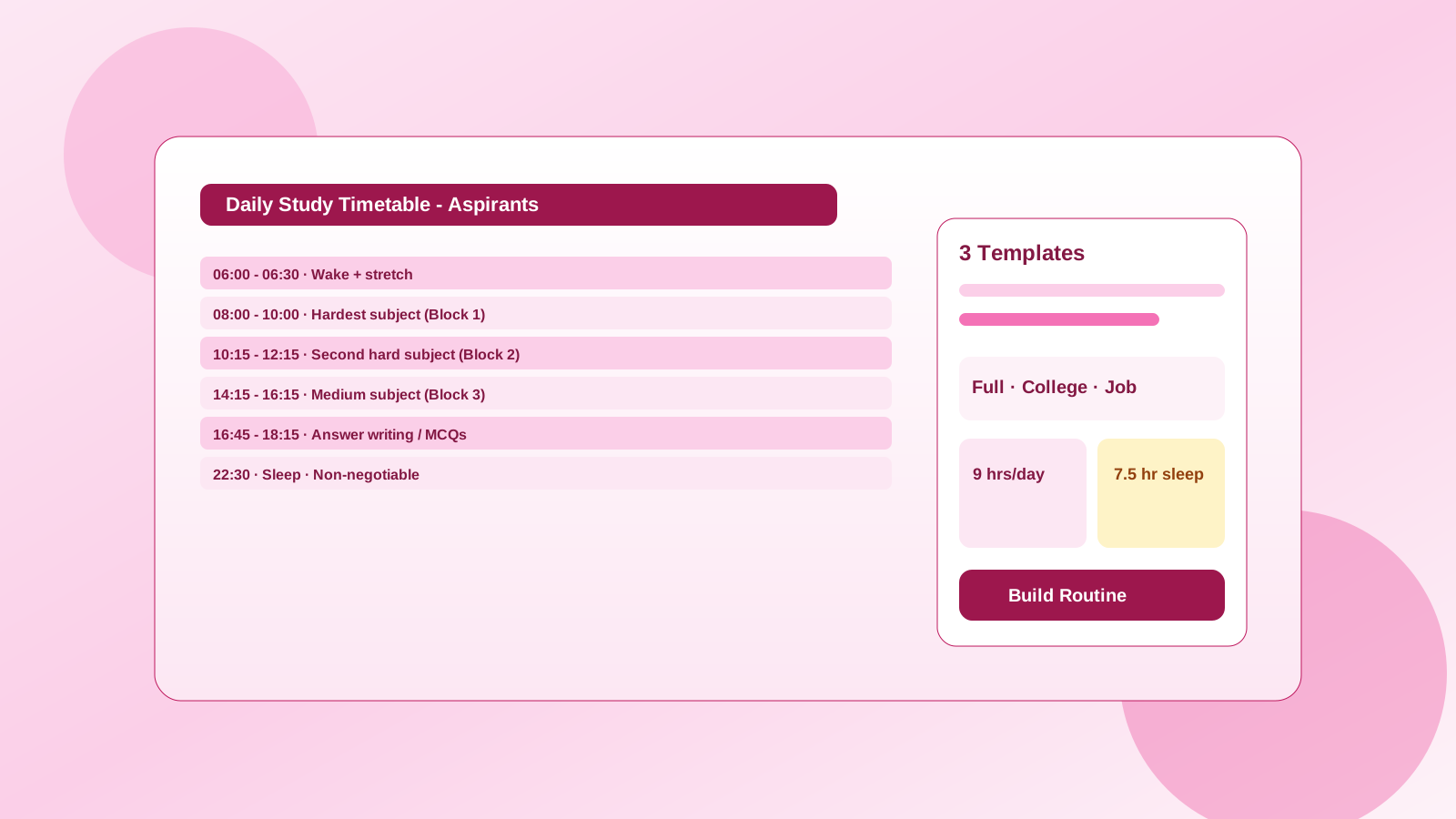
This is the gold standard - 9 to 10 hours of focused study with rest, exercise and family time built in. Sustainable for 12 to 18 months.
| Time | Block | Activity |
|---|---|---|
| 06:00 to 06:30 | Wake up | Stretch, water, no phone |
| 06:30 to 07:15 | Exercise | Walk, yoga or light cardio |
| 07:15 to 08:00 | Breakfast + revision | Re-read yesterday's notes |
| 08:00 to 10:00 | Study Block 1 | Hardest subject (Quant / Polity / Optional theory) |
| 10:00 to 10:15 | Break | Tea, no screens |
| 10:15 to 12:15 | Study Block 2 | Second hard subject (History / Economy / Optional practice) |
| 12:15 to 13:15 | Newspaper + notes | Read editorial, write 3 to 5 current-affairs points |
| 13:15 to 14:15 | Lunch + power nap | Max 25-min nap, no longer |
| 14:15 to 16:15 | Study Block 3 | Medium subject (Geography / GA / Reasoning) |
| 16:15 to 16:45 | Break | Walk outside, sunlight |
| 16:45 to 18:15 | Study Block 4 | Answer writing or MCQ practice |
| 18:15 to 19:15 | Mock test review | Re-read mistakes from yesterday's mock |
| 19:15 to 20:30 | Dinner + family time | Off-screen |
| 20:30 to 22:00 | Light study | Magazine (Yojana / Kurukshetra) or revision |
| 22:00 to 22:30 | Plan tomorrow | 5-minute timetable review, switch off phone |
| 22:30 to 06:00 | Sleep | 7.5 hours - non-negotiable |
Total focused study: 9 hours + revision + answer writing.
3. Timetable for College Students (3 to 4 Hours of Daily Prep)
College life adds classes, attendance, projects and a social calendar. The trick is to convert dead time into study time, not to compete with full-time aspirants.
| Time | Block | Activity |
|---|---|---|
| 06:30 to 07:15 | Wake + exercise | 30-min walk or jog |
| 07:15 to 08:30 | Study Block 1 | NCERT / Optional foundation |
| 08:30 to 09:30 | College commute + breakfast | Audio - listen to PIB / All India Radio podcast |
| 09:30 to 16:00 | College | Use free periods for previous-year MCQs (mobile app) |
| 16:00 to 17:00 | Newspaper + current affairs | The Hindu editorial + 5-line summary |
| 17:00 to 19:00 | Study Block 2 | Polity / History / Economy - 1 chapter daily |
| 19:00 to 21:00 | Dinner + family + social | Off-screen, mental rest |
| 21:00 to 22:30 | Study Block 3 | Answer writing (1 question / 2 GS questions) or MCQ practice |
| 22:30 to 23:00 | Revision | 15-min flashcard recap of week's topics |
| 23:00 to 06:30 | Sleep | 7.5 hours |
Total focused study: 4 to 5 hours on weekdays + 8 to 10 hours on weekends.
College weekend strategy:
- Saturday morning: full-length sectional mock (90 minutes) + analysis (60 minutes).
- Sunday morning: weekly revision of all topics covered.
- Sunday evening: rest, family, hobby - one full off-block to prevent burnout.
4. Timetable for Working Professionals (3 to 4 Hours of Daily Prep)
This is the most demanding life situation - 9-hour job + 1 to 2 hour commute + family responsibilities. The framework:
| Time | Block | Activity |
|---|---|---|
| 05:30 to 06:00 | Wake + tea | No phone |
| 06:00 to 08:00 | Study Block 1 | Highest concentration block - hardest subject of the day |
| 08:00 to 09:00 | Breakfast + commute prep | Listen to current affairs podcast or Yojana audio |
| 09:00 to 10:00 | Commute | Read e-newspaper or revise flashcards on phone |
| 10:00 to 18:30 | Office | Use lunch break (30 min) for 25 MCQs from PYQ app |
| 18:30 to 19:30 | Commute home | Audio revision or mock test review |
| 19:30 to 20:30 | Dinner + family | Off-screen, recharge |
| 20:30 to 22:30 | Study Block 2 | Static subject + answer writing (1 question / day) |
| 22:30 to 23:00 | Plan tomorrow + revision | Recap day's topics in 15 minutes |
| 23:00 to 05:30 | Sleep | 6.5 hours minimum |
Total focused study: 4 hours weekdays + 8 to 10 hours each weekend day.
Working professional truths:
- Plan the timeline as 18 to 24 months, not 12. Trying to match a full-time aspirant's plan leads to burnout in 3 months.
- Saturdays are for full-length mocks, Sundays for revision and rest.
- Use one annual leave block (15 to 20 days) before Prelims for the final sprint.
- Tell your manager (only after promotion is confirmed) - sometimes work-from-home flexibility opens up.
5. Sample Subject Rotation - 7 Day Plan
Same time blocks, different subjects each day. This rotation ensures every subject gets attention twice a week minimum.
| Day | Block 1 (Morning) | Block 2 (Late Morning) | Block 3 (Afternoon) | Block 4 (Evening) |
|---|---|---|---|---|
| Monday | Polity | Modern History | Geography | Answer writing GS-2 |
| Tuesday | Economy | Ancient + Medieval History | Environment | MCQ practice + CSAT |
| Wednesday | Optional Paper 1 | Polity revision | Science and Tech | Answer writing GS-3 |
| Thursday | Optional Paper 2 | Modern History revision | Geography revision | Answer writing GS-1 |
| Friday | Polity | Economy revision | Internal Security | Answer writing GS-4 (Ethics) |
| Saturday | Full-length mock test | Mock analysis | Weak topic revision | Essay writing |
| Sunday | Weekly revision (all 6 days) | Optional revision | Off / Family | Plan next week |
For SSC CGL, replace Polity / History / Geography with Quant / Reasoning / English / GA in roughly the same rotation.
6. The 90-Day Mock Test Cycle
Mocks are not optional - they are the single best diagnostic tool you have.
| Stage | Frequency | Focus |
|---|---|---|
| Day 90 to 60 | 1 sectional + 1 full mock per week | Identify weak topics |
| Day 60 to 30 | 2 sectional + 1 full mock per week | Speed and accuracy improvement |
| Day 30 to 15 | 1 sectional + 2 full mocks per week | Exam temperament practice |
| Day 15 to 5 | 1 full mock every alternate day | Stamina and time management |
| Day 5 to 1 | No new mocks | Pure revision only |
After every mock, spend double the test time on analysis. A 1-hour mock deserves 2 hours of careful review - error log, reasoning behind every wrong answer, topic-wise accuracy chart.
7. The Revision Cycle - Where Most Plans Fail
Toppers revise every topic at least 3 to 5 times. Aspirants who fail usually revise once. Use this layered cycle:
- Daily revision: last 30 minutes before sleep - re-read today's notes.
- Weekly revision: every Sunday morning - re-read this week's summary notes for all subjects.
- Monthly revision: last weekend of every month - solve a 100-question MCQ paper from PYQs covering only the month's topics.
- Quarterly revision: every 3 months - one full-length mock + complete subject sweep.
- Pre-exam revision: last 30 days - no new content, only revision and mocks.
The compound effect: a topic studied once and revised 4 times has 4x the retention of a topic studied four times without dedicated revision.
8. Productivity Hacks Backed by Research
- Phone in another room. Studies show even a face-down phone on the desk reduces working memory by 10 to 20%.
- Use a physical timer. Visible countdown beats a phone timer because no notifications interrupt.
- Study at the same desk daily. Consistent location triggers a study mindset within 5 minutes.
- Wear "study clothes". Dressing differently for study (not pyjamas) signals your brain to switch modes.
- 2 minutes of deep breathing between blocks resets cortisol and improves focus.
- Drink water every hour. Mild dehydration drops cognitive performance by 10%.
- Get 15 minutes of morning sunlight. Sets your circadian rhythm for the day - improves both focus and sleep.
9. The Burnout Warning Signs
Watch for these and act before they spiral:
- Sleeping under 6 hours for more than 3 nights in a row.
- Skipping mocks because "I am not ready" repeatedly.
- Re-reading the same paragraph 3 times without comprehension.
- Cancelling all family / friend interactions for more than 4 weeks.
- Persistent low mood or unexplained anxiety.
When you see 2 or more signs - take a 48-hour off block immediately. Sleep, walk, eat real food, talk to family. You will return to study with double the productivity. Burnout costs months; rest costs days.
10. Building Your Personal Plan - 4 Step Checklist
- Step 1: Honestly count your "real available study hours" per day - not aspirational hours.
- Step 2: Pick one of the three templates above as your starting framework.
- Step 3: Customise subject rotation to your weakest subjects (give them 3 slots a week, not 2).
- Step 4: Print the timetable, stick it above your desk, and follow it for 21 straight days. Habits crystallise around day 21.
11. Free Tools to Track Your Timetable
- Notion / Trello - free templates for daily and weekly tracking.
- Forest app - blocks phone for set study sessions, builds a virtual forest.
- Google Sheets - simple subject vs hours grid, updated daily.
- A physical planner - many toppers swear by paper over apps for daily tracking.
Track three things every day:
- Hours studied (planned vs actual).
- Topics covered (chapters, page numbers).
- Mocks attempted + accuracy.
After 30 days, the data tells you exactly which subjects are getting under-served.
12. Bottom Line
A timetable does not crack the exam - the daily discipline of following it does. Pick the template that matches your life, follow it for 21 days, then refine. By month 3, you will have a personalised system that is more powerful than any coaching schedule.
For exam-specific study planners, daily MCQ challenges, mock test analytics that auto-detect your weak topics, and revision modules built around the principles above, explore the preparation tools on ApnaTestPrep.